The Digital Twin
Most apps track what you do. Downshiftr tracks what your body is doing — and uses that to explain why.
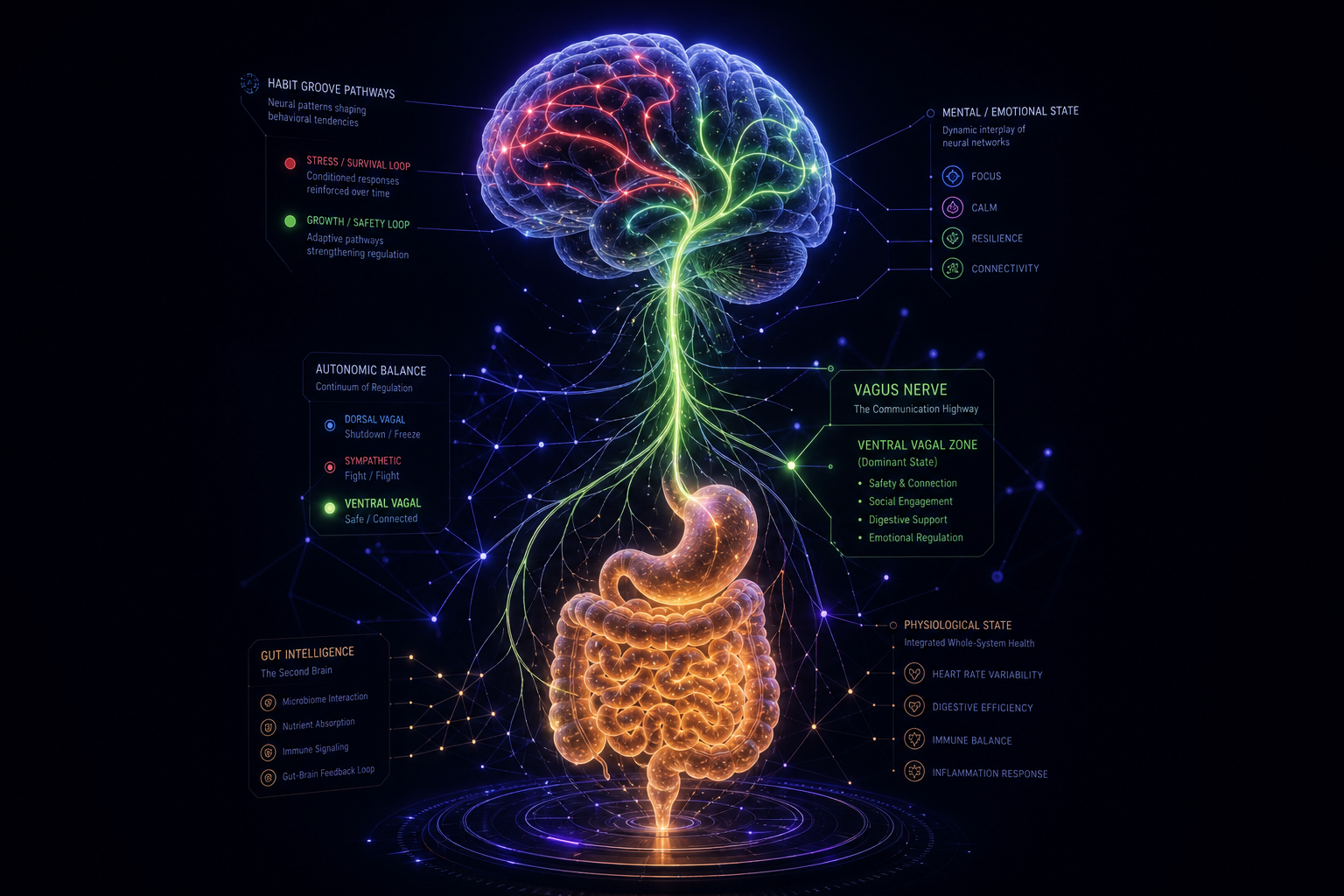
The digital twin is a living 3D model of you as a biological system. It has three layers, because you have three layers:
Layer 1: The Brain
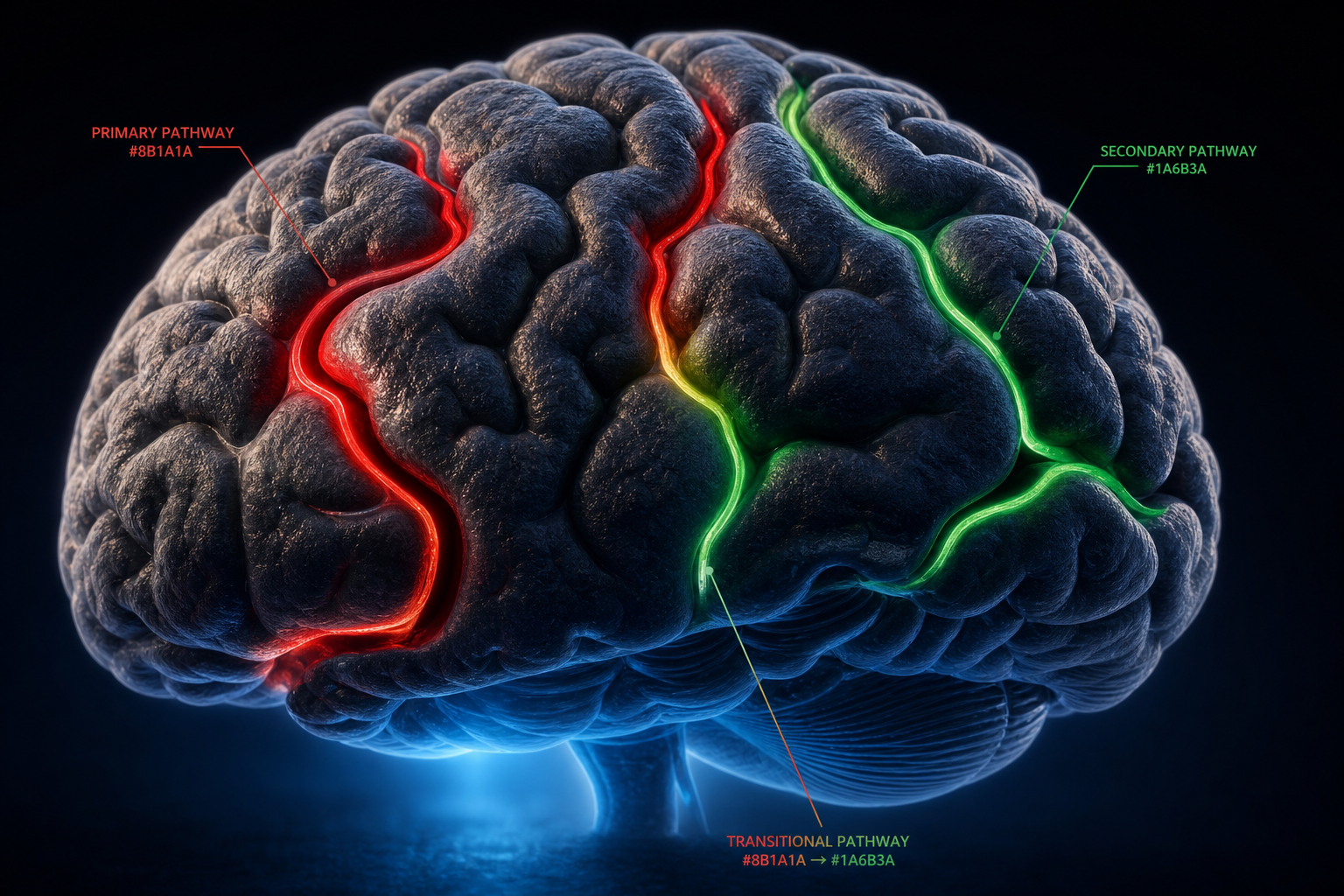
The habit map. Cortical grooves that glow red or green based on the ratio of old versus new pathway decisions. Graph-database aesthetic — each groove is a named pathway, each decision is an event that nudges its color.
The brain is the most visible layer. It’s where the change you’re working toward becomes something you can see.
But the brain layer does more than visualize. The app watches the rolling decision ratio per state — not just per habit. Over time it builds a picture of which of the 22 nervous system states you tend to make new-pathway choices from, and which states route back to the old pathway regardless of intention. This is not generic advice about “being in a good state.” It is a model of your own change capacity, derived from your own decisions, specific to each habit pair.
The pattern this surfaces is often surprising: not “you need more willpower” but “you make the new-pathway choice from Focused Attention and almost never from Performance/Pressure — so the question is what happens before the trigger fires, not at the trigger itself.”
Layer 2: The Vagus Nerve
Extending downward from the brainstem, the vagus nerve is the communication channel between your brain and your body. It branches into dozens of tendrils that innervate your heart, lungs, gut, and more.
80% of vagus nerve fibers run afferent — body to brain. Not the other way. The loudness of your emotions, the urgency of your panic, the weight of your grief — these are signals your body is sending to your brain, not thoughts your brain is generating.
This is the most important piece of biology the app teaches. And it changes everything. When you understand this, you stop trying to think your way out of a body state. You go to the body first.
The twin shows the vagus nerve in three polyvagal zones:
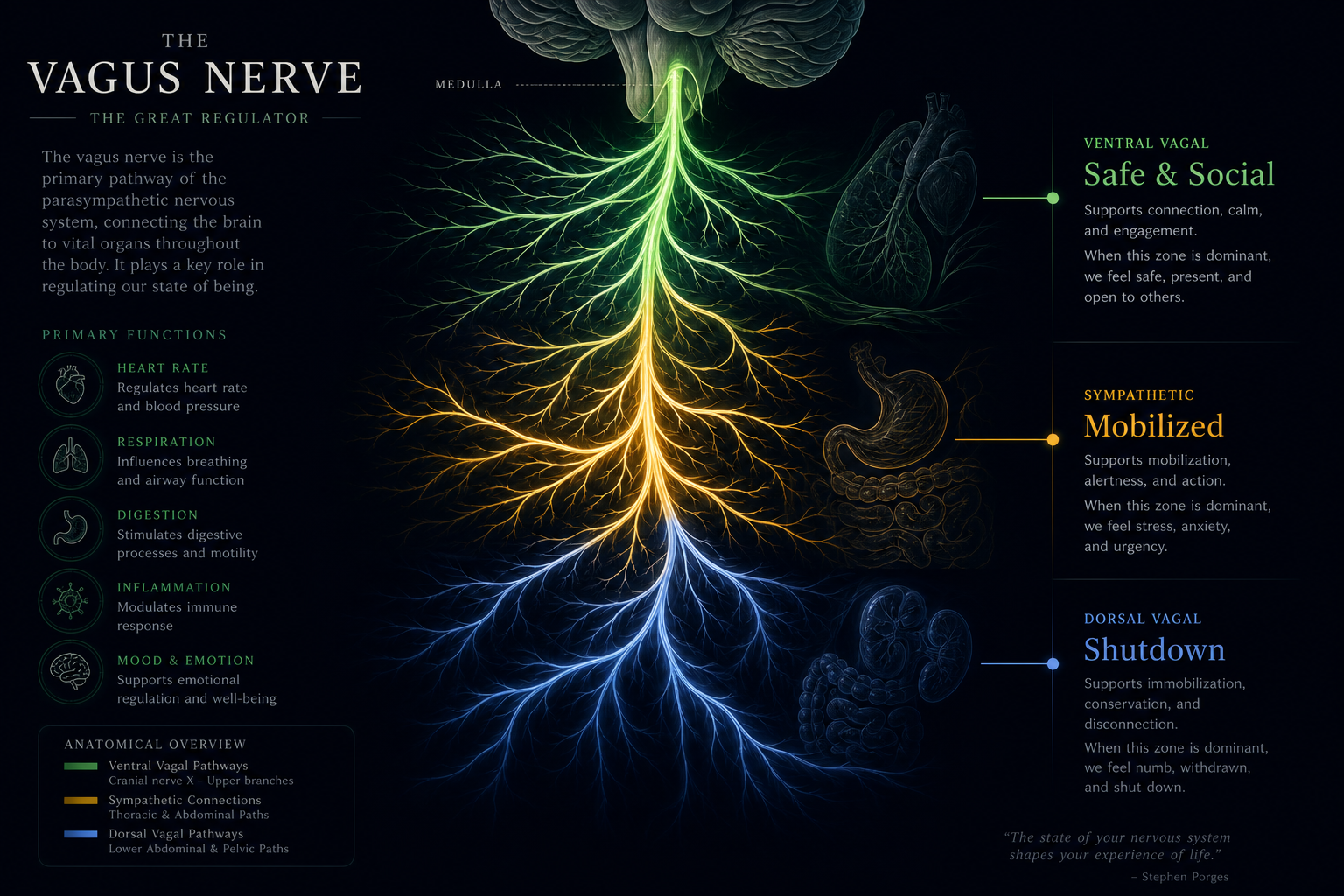
| Zone | State | Governs |
|---|---|---|
| Ventral vagal | Safe and social | Connection, learning, play, calm |
| Sympathetic | Mobilized | Fight/flight, urgency, pressure |
| Dorsal vagal | Shutdown | Freeze, collapse, dissociation |
The twin shows which zone is currently illuminated — and shows when cycles are running or completing.
The polyvagal zone is the gate between the metabolic layer and the brain layer. In dorsal vagal shutdown, the cortex is partially disconnected from executive function — the habit layer cannot update regardless of intention. In sympathetic flooding, pattern execution takes over from deliberate choice. Only within the window of tolerance — ventral vagal or close to it — does the brain map become writable.
This is why the twin shows the vagus nerve, not just the brain. The brain map alone can’t explain why you couldn’t make the new-pathway choice in that moment. The vagus layer can.
For the full biology of how zones work and how to move between them, see Polyvagal Theory.
Layer 3: The Metabolism
Stomach. Intestines. The gut-brain axis visualized. Connected upward to the brain via the vagus nerve’s tendrils.
The metabolic layer shows the fuel state of the entire system:
- Food status — when you last ate, and the macro balance
- Hydration
- Sleep debt
- Substances — shown as a translucent interference layer over the entire twin
When the metabolism is depleted, the twin appears dimmer. Not as punishment. As information. This is what depletion looks like in the system.
But the metabolic layer isn’t passive monitoring. It actively surfaces explanations and intervenes. When your last meal was more than five hours ago and you’re registering a low-agency, high-distress state, the app names that: “Your nervous system is running depleted. This affects which states you can access. The first intervention isn’t habit work — it’s food.”
When substances are in the system, the interference layer shows what that looks like across the whole twin — how the vagal tone is suppressed, how the brain layer’s update capacity is reduced, how the cycle-completion mechanism is being bypassed. The display is not moralistic. It is informational. This is the biology of what’s happening.
The metabolic layer is the foundation everything else sits on. A depleted, undersupported nervous system will default toward shutdown or flooding regardless of habit intentions — not because of weakness, but because the substrate for deliberate choice isn’t available. See Metabolic Layer for the full progression of metabolic support.
The Spider Graph
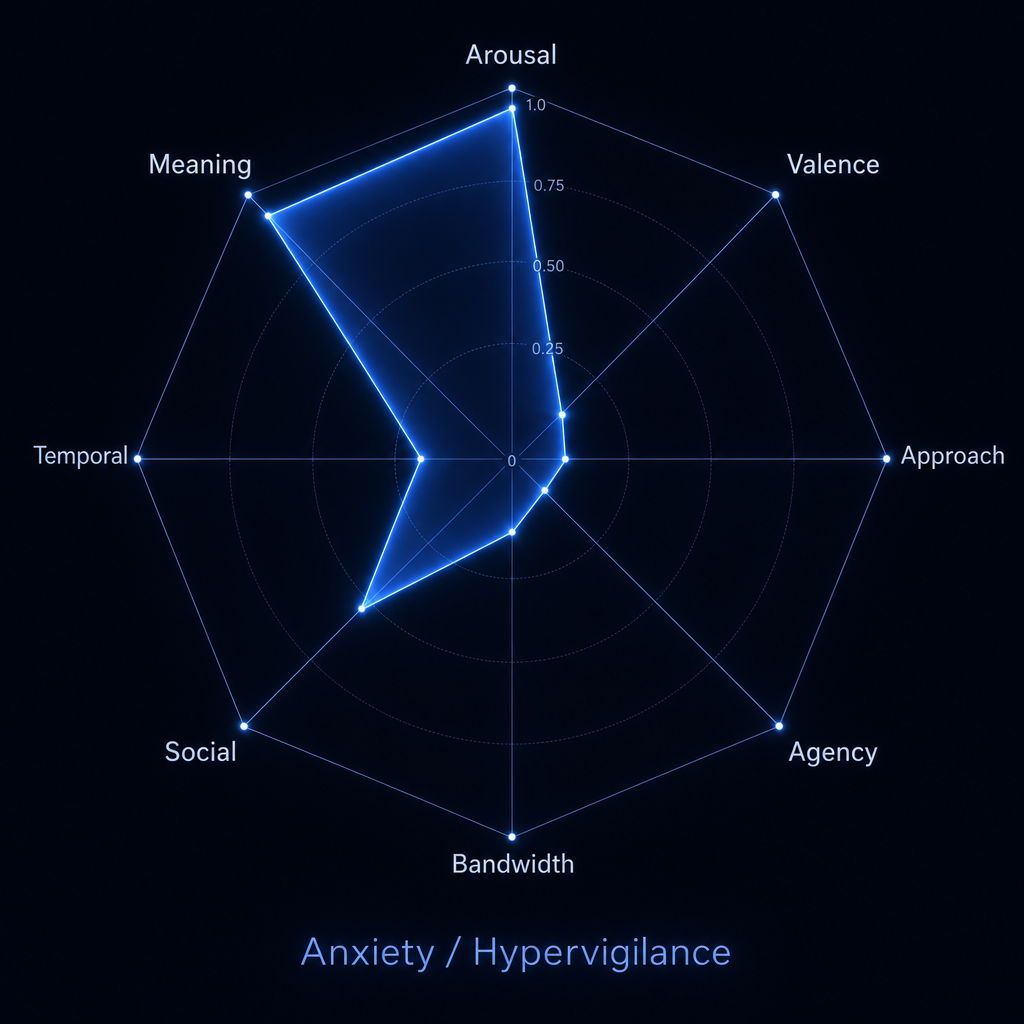
Your dimensional state is shown as an 8-axis radar/spider chart. The shape of the polygon is named as one of 22 nervous system states.
You don’t have to know the 22 states. But over time, you’ll start recognizing your own shapes. The high-arousal, narrow-bandwidth polygon that means you’re in anxiety mode. The low-agency, aversive-valence shape that means you’re in freeze.
That recognition — seeing your state as a shape before you’ve consciously labeled it — is interoception. The app builds it through repetition.
Growing More Accurate Over Time
The twin is not static. The more you use it, the more it reflects your actual patterns:
- “You make better choices when agency is above 4”
- “Your chaos panic resolves fastest with grounding + box breathing”
- “You tend to be in dorsal shutdown on days when you haven’t eaten by noon”
The goal is a twin that can anticipate, not just reflect. That notices before you do. That helps you see the pattern before it’s running you.