Metabolic Layer
This page focuses on cannabis and alcohol — the two most common substances used as daily nervous system regulation tools. They are not the same, but they share a key property: the nervous system learns to use them to shift state on demand, and eventually stops learning to shift state any other way.
Important safety note: Severe alcohol dependency (drinking daily for extended periods, or experiencing shaking, sweating, or seizures when stopping) requires medical supervision. Alcohol withdrawal can be life-threatening. Do not attempt to stop abruptly without talking to a doctor first.
Other substances — benzodiazepines, stimulants, opioids — are also seriously physically addictive and require medical support to stop safely. This page is not for those situations.
For cannabis and habitual (but not severely dependent) alcohol use, what follows is relevant. The claim is significant but grounded: you can retrain your brain to want healthier things in the moments it currently wants these substances — without white-knuckling, without cravings, without telling yourself “never.”
Why They Work
Your brain learned something true: cannabis and alcohol reliably shift your nervous system state. Cannabis blunts amygdala reactivity — the threat signals get quieter. Alcohol mimics GABA, the brain’s primary inhibitory neurotransmitter — producing a chemical approximation of the parasympathetic rest state. Both work. That’s not the problem.
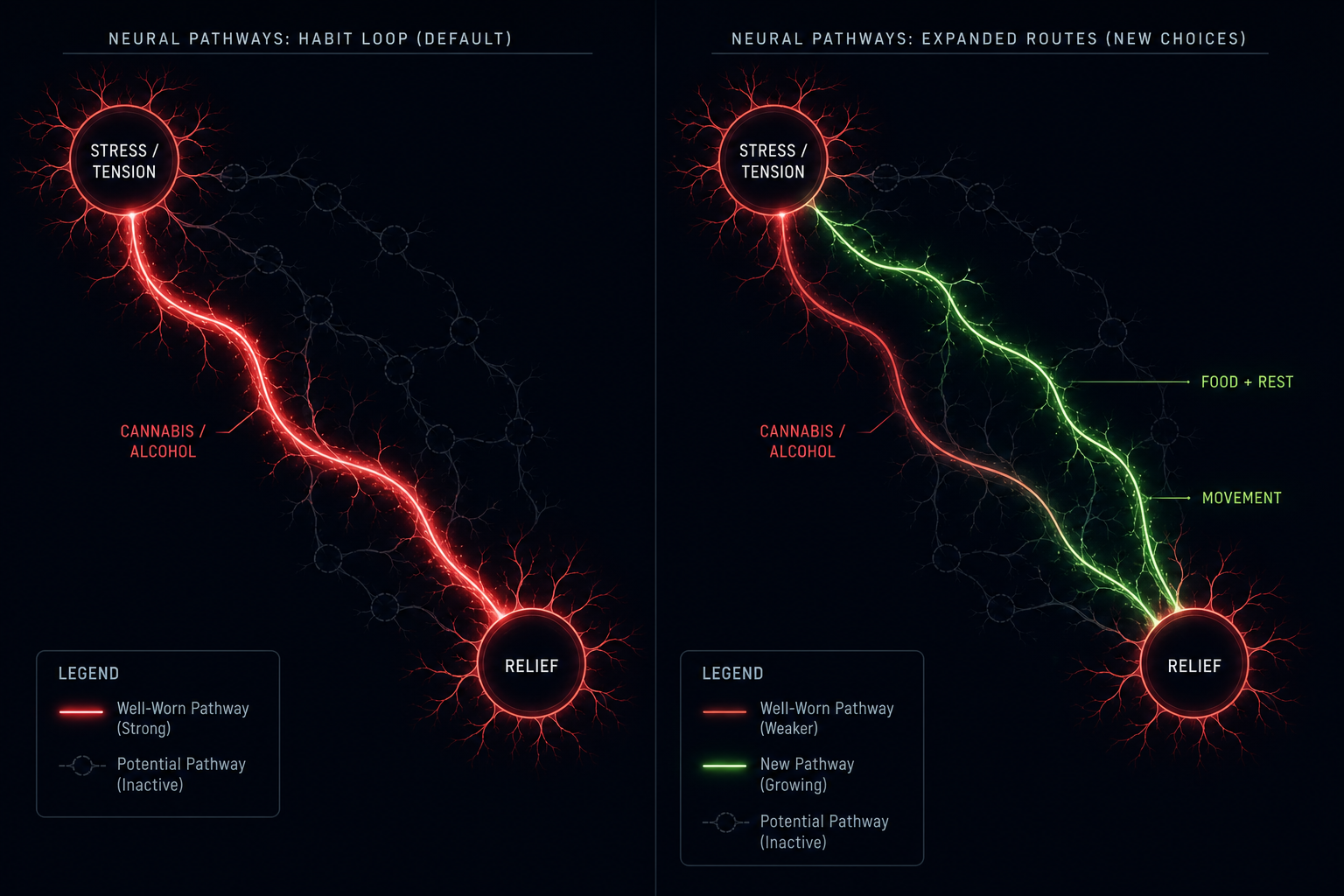
The problem is that the brain, being an efficient learner, generalizes: “When I need relief, this is how I get it.” Over time, that becomes the only pathway it knows. Other pathways — food, movement, rest, connection — atrophy from disuse, or never get built in the first place.
You don’t have a willpower problem. You have a routing problem. The brain has one route to relief, and it takes it every time, because it works every time.
The “Not Right Now” Approach
This system does not ask you to say never. It asks you to say: “Not right now — later, if I still want it. But first, let me try eating and moving, and then see how I feel after.”
This matters because the brain changes through repetition, not through resolution. Every time you route toward food and movement instead of the substance, you are activating the new pathway. Every time the new pathway produces relief — and it will — you are writing new reward data. Over time, the brain starts to predict that food and movement will provide relief, and begins to want them in the moments it previously wanted the substance.
The substance remains an option. It’s not forbidden. You’re just seeing whether the other thing works first. Usually, it does. And over enough repetitions, the craving itself changes — not because you suppressed it, but because the brain genuinely started to prefer the new route.
The goal is not willpower. It is rerouting through repetition — until the brain wants the better thing on its own.
Food as the First Regulation Tool
When you’re stressed, depleted, or feeling the pull toward cannabis or alcohol, the first question is almost always metabolic: have you eaten enough, and was it the right kind of food?
Cannabis and alcohol both suppress hunger signals. If you’ve been using either habitually, you are very likely underestimating your caloric needs — often by 30–50%. The emotional discomfort you’re feeling may be partly or entirely metabolic. The brain is asking for fuel, and you’ve learned to answer that request with a substance.
Salt and fat first. This is not comfort food as distraction — this is direct nervous system support:
- Salt supports adrenal function and electrolyte balance; low sodium raises cortisol
- Fat provides sustained fuel for nervous system function, myelin maintenance, and hormone production
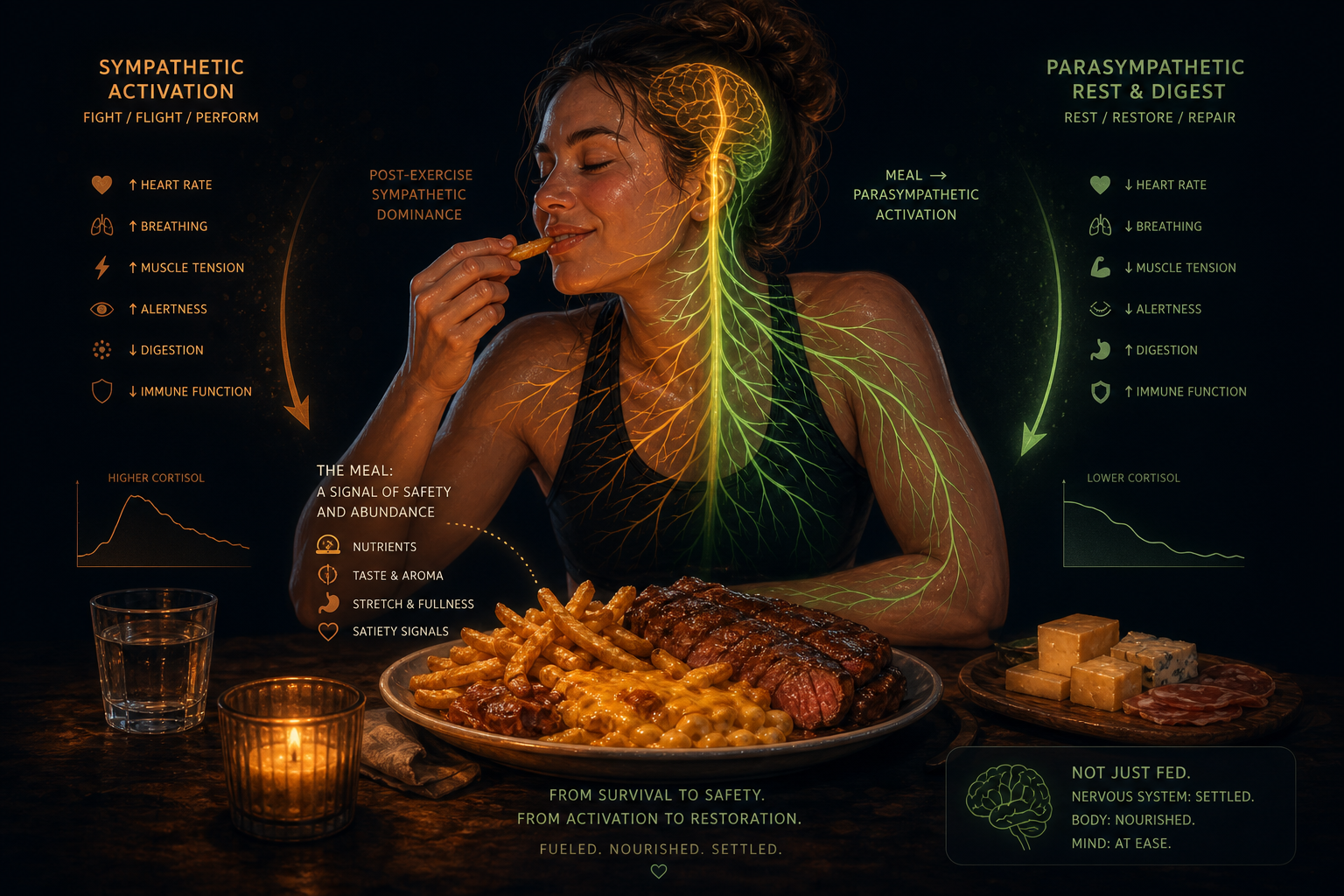
- The combination produces a measurable shift in the felt sense of the nervous system — a settling, a heaviness releasing, a reduction in edginess — that is genuinely similar to what cannabis and alcohol produce, through a different mechanism
Carbohydrates on top amplify and extend the effect. Protein becomes increasingly important as the system stabilizes.
The salty, fatty meal after exertion — after a workout, after a long day, after a difficult emotional event — produces a legitimate downshift. It is slower than a drink or a hit. The brain takes time to learn this is satisfying. But it will learn it, if you give it the data.
Movement as the Second Tool
Exercise triggers many of the same neurochemical pathways that cannabis and alcohol target — through earned, non-borrowed means:
- Endocannabinoids (including anandamide, literally named from the Sanskrit word for bliss) are released naturally during sustained exercise — the same receptors cannabis binds to
- GABA activity increases post-exercise — the same inhibitory effect alcohol produces
- Endorphins reduce pain and produce mild euphoria
- BDNF (brain-derived neurotrophic factor) promotes new neural growth — the biological substrate of plasticity
Exercise is also one of the most reliable completers of nervous system cycles. The sympathetic activation that builds during stress has a natural outlet in physical exertion. After real movement, the system wants to rest in a way that mirrors parasympathetic rest — not because you chemically forced it, but because the cycle completed.
Exercise and Panic
Many people who want to use exercise as regulation avoid it because exercise triggers panic. Heart rate elevation feels like anxiety. Exertion feels like loss of control. Sweating and breathlessness trigger threat responses. This is real, common, and exactly what this app is built to help with.
The panic button is available before, during, and after exercise. The habit pair framework can be used directly: the trigger is “time to exercise,” the old pathway is avoidance or giving up, the new pathway is starting — not finishing, not performing well, just beginning.
Starting is the habit. The brain doesn’t need to learn to love exercise. It needs to learn that starting doesn’t lead to catastrophe.
How the Brain Relearns
The transition looks like this:
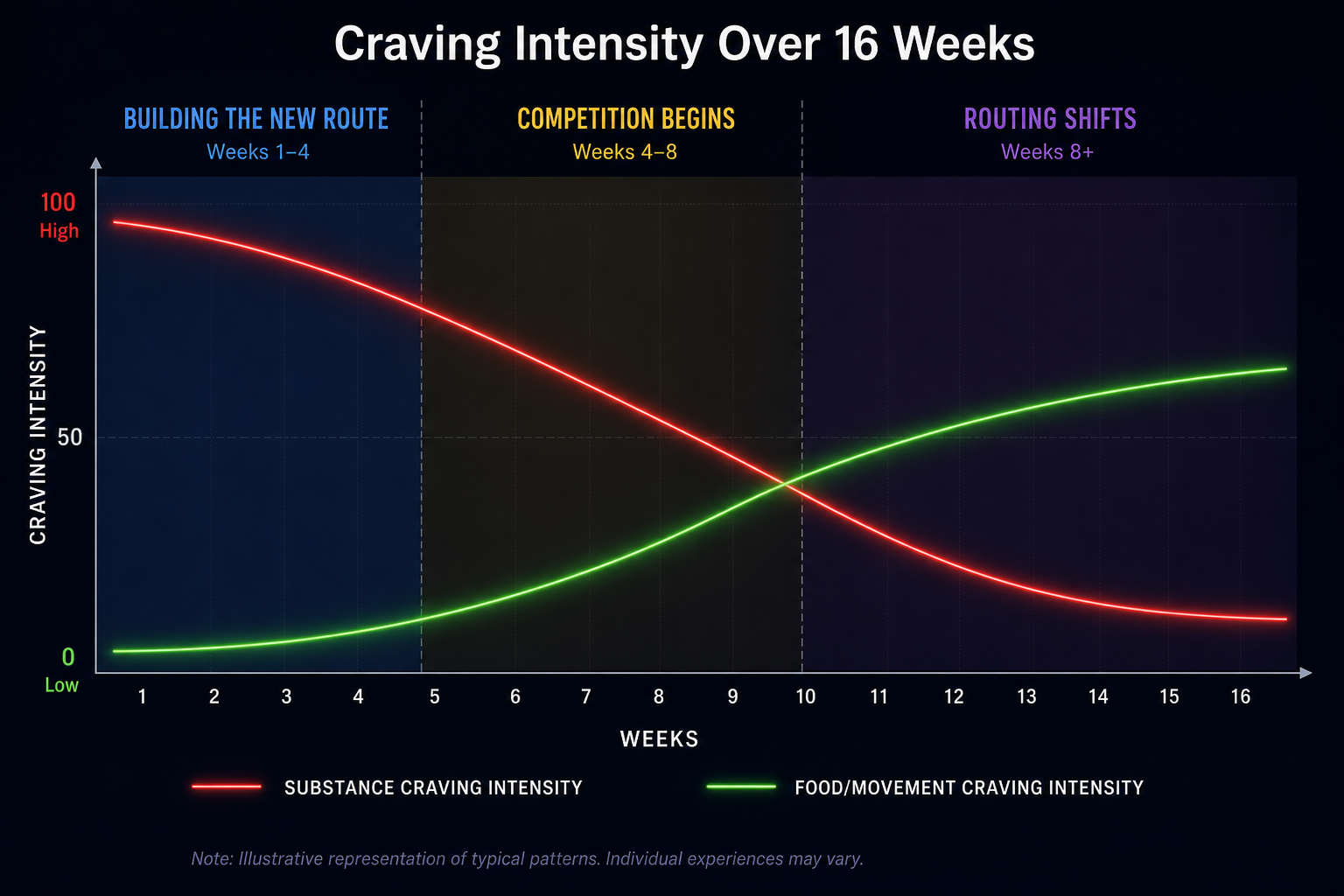
Week 1–4: Food and movement feel like substitutes — lesser, slower versions of the relief you’re used to. The brain knows the substance works faster. This is accurate. You are not wrong that the old route is more efficient. You are building a new route that doesn’t exist yet.
Week 4–8: The food + movement combination starts to feel genuinely satisfying in contexts where you used to reach for the substance. Not every time. But enough that the brain begins to build a prediction: this works. The pull toward the substance in those moments begins to weaken — not because you suppressed it, but because the new route is starting to compete.
Week 8–16: The craving pattern shifts. The brain starts to generate the food/movement want in the moments it previously generated the substance want. Not from discipline — from learning. The old route is still there; it just has competition now.
Beyond: The substance is no longer a relief mechanism — it’s a choice made from a regulated state, not a dysregulated one. Some people find they still enjoy it occasionally, differently. Others find they’ve lost interest. Both are fine. The key is the routing: relief through regulation, not relief through borrowing.
Why This Is Different From Willpower-Based Approaches
AA and most abstinence programs rely primarily on co-regulation — the support of other people’s regulated nervous systems to supplement your own. This works. Human presence is a genuine regulation tool. But it creates dependency on external availability, and it doesn’t address the underlying metabolic and interoceptive deficits that made the substance necessary in the first place.
This approach adds something AA and most programs don’t address: independent metabolic regulation. Building the body’s own capacity to produce the neurochemical environment the substance was producing — through food, movement, sleep, and over time, social engagement — means the regulation capacity is yours, not borrowed from a sponsor or a meeting.
The result is that things people describe as hard become significantly easier — not because you became more disciplined, but because you stopped asking a depleted, undertrained nervous system to do something it genuinely couldn’t do, and started building the actual infrastructure for what you were asking of it.
Your brain learned it could get instant relief from cannabis or alcohol. It can learn that food and movement feel better, last longer, and compound into feeling better all the time. That is not a motivational claim. It is a description of how the dopamine prediction system works when it gets accurate, repeated data.
The data is your life. Give it different data, consistently, and it will update.