Metabolic Layer
Most regulation advice focuses on breath and thought. Both matter. But the most powerful and most overlooked tool for nervous system change is full-body integrated movement — and the science behind why is the same science behind everything else in Downshiftr.
Why Movement Changes the Brain
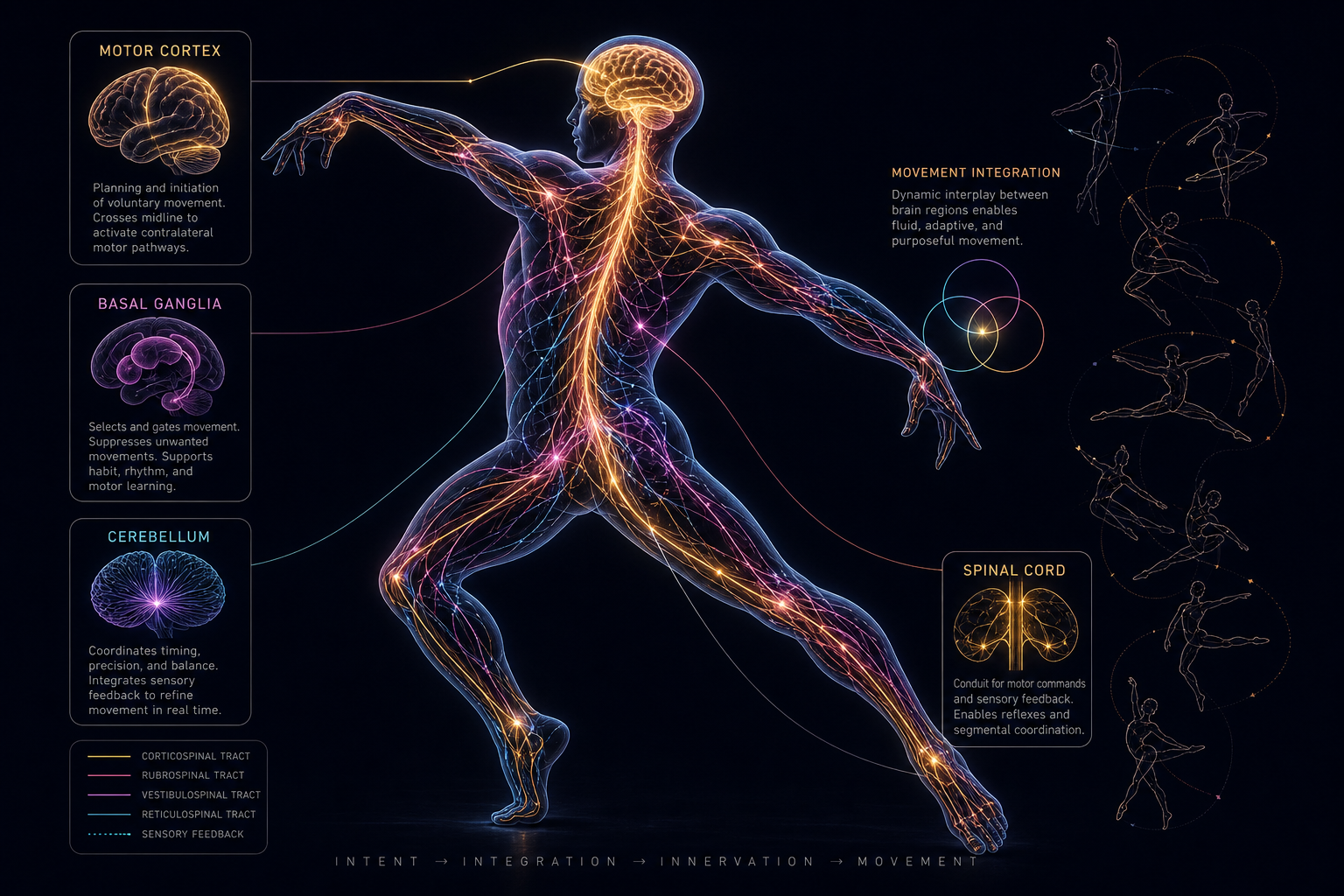
The same mechanism that rewires habit pathways — repeated activation building new neural connections — applies to movement. Every time you learn a new movement pattern, you are literally carving new neural grooves in the motor cortex, cerebellum, and basal ganglia. You are practicing neuroplasticity.
This matters for habit change because the brain that has learned to learn movement transfers that capacity. A nervous system that has spent years acquiring new physical vocabularies — new shapes, new timing, new weight relationships — is a nervous system that knows how to change. The plasticity is there, exercised, warm.
Full-body movement also does something that isolated gym movement doesn’t: it integrates the nervous system across the entire body. Industrialized exercise breaks the body into parts — leg day, chest day, core. Integrated movement requires the whole organism to coordinate and express. And that full-body coordination activates neural integration that supports regulation, emotional processing, and habit change in ways that segmented movement cannot.
Rudolf Laban and the Language of Movement
Rudolf Laban (1879–1958) developed the most comprehensive system for understanding and notating human movement ever created. His framework, Laban Movement Analysis (LMA), is used by dancers, physical therapists, actors, and movement researchers worldwide.
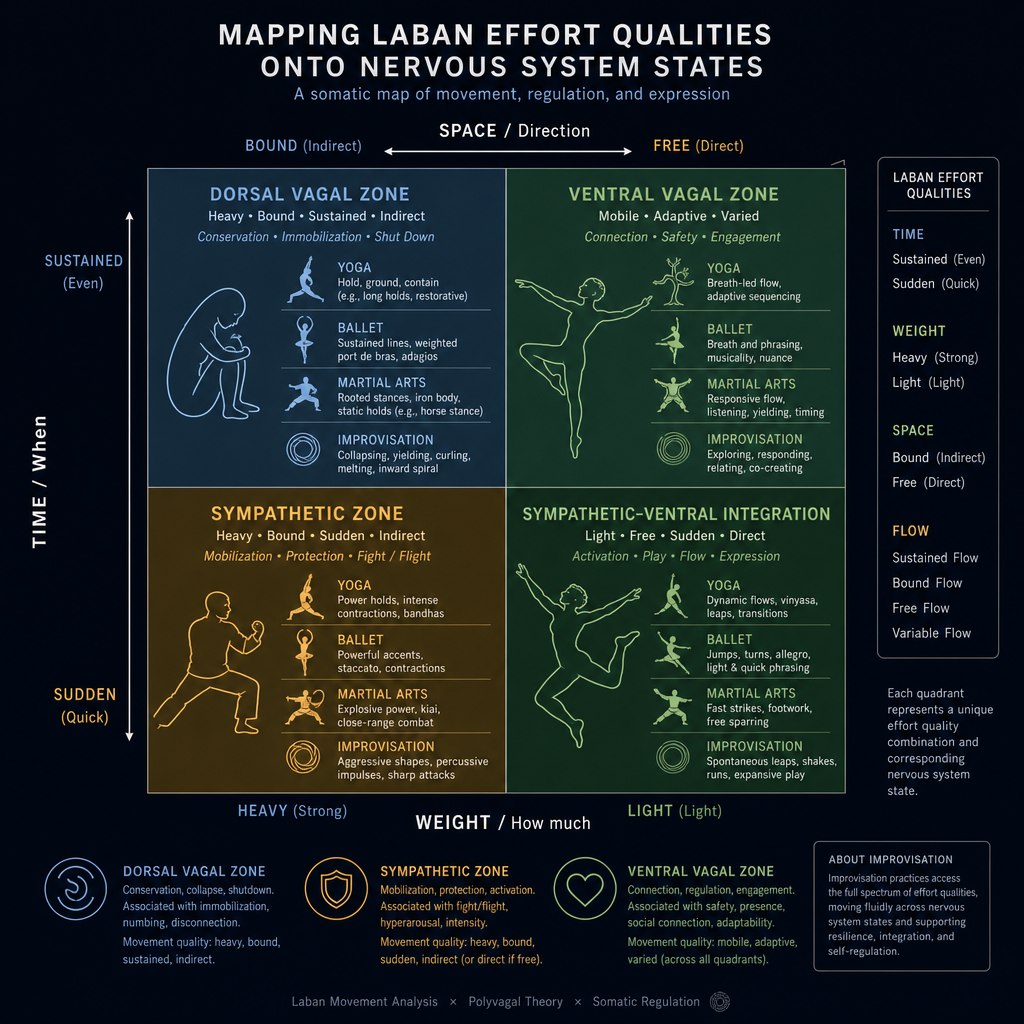
What makes it relevant here: Laban described movement not as technique but as effort — the inner attitude that animates the outer shape. He identified four effort qualities, each with a spectrum:
| Effort | Indulgent ↔ Condensed |
|---|---|
| Time | Sustained (slow, melting, taking time) ↔ Sudden (quick, urgent, explosive) |
| Weight | Light (buoyant, effortless, floating) ↔ Strong (heavy, committed, pressing) |
| Space | Indirect (wandering, flexible, multi-directional) ↔ Direct (focused, piercing, aimed) |
| Flow | Free (uncontrolled, abandoned, streaming) ↔ Bound (controlled, held, restrained) |
These effort qualities map strikingly well onto nervous system states. Dorsal vagal shutdown produces bound, heavy, sustained, indirect movement. Sympathetic activation produces sudden, strong, direct, free movement. Ventral vagal produces mobile, adaptive, varied combinations.
Why this matters for regulation: By deliberately working in different effort qualities, you can shift your nervous system state through the body — not through thought. Choosing to move with sustained, light, free quality doesn’t just express a calm state; it begins to produce one.
Movement Traditions and Their Nervous System Signatures
Different movement disciplines work in different effort ranges — which is why cross-training across disciplines builds more complete nervous system integration than any single practice.
Ballet: Predominantly light, sustained, direct, controlled. Develops precision, spatial awareness, and bound flow control. Strong ventral vagal training. The sustained quality is particularly regulatory.
Martial arts: Sudden, strong, direct, with rapid transitions into bound. Develops sympathetic mobilization with clean completion — the activation fires and then settles. Excellent for learning to complete nervous system cycles rather than suppress them.
Yoga: Sustained, strong (weight-bearing), bound, with emphasis on direct spatial intention. One of the best practices for dorsal vagal recovery — the held poses force engagement with immobilization without panic, gradually rebuilding tolerance for stillness that isn’t shutdown.
Gymnastics: Full range, multi-planar, requires spatial orientation across all axes. Trains the vestibular system (inner ear) and proprioception heavily — both of which contribute directly to interoception.
Improvisational modern dance: The highest-integration practice. Requires continuous real-time adaptation of effort quality, spatial relationship, timing, and weight. No pre-determined pattern to follow. The brain must remain in a state of alert, open attention — precisely the ventral vagal, moderate-bandwidth state that supports habit change. Working with others in structured improvisation adds the social engagement layer.
Full-body improvisational movement may be the closest thing to a direct workout for the prefrontal cortex in coordination with the entire nervous system.
Movement as Nervous System Cycle Completion
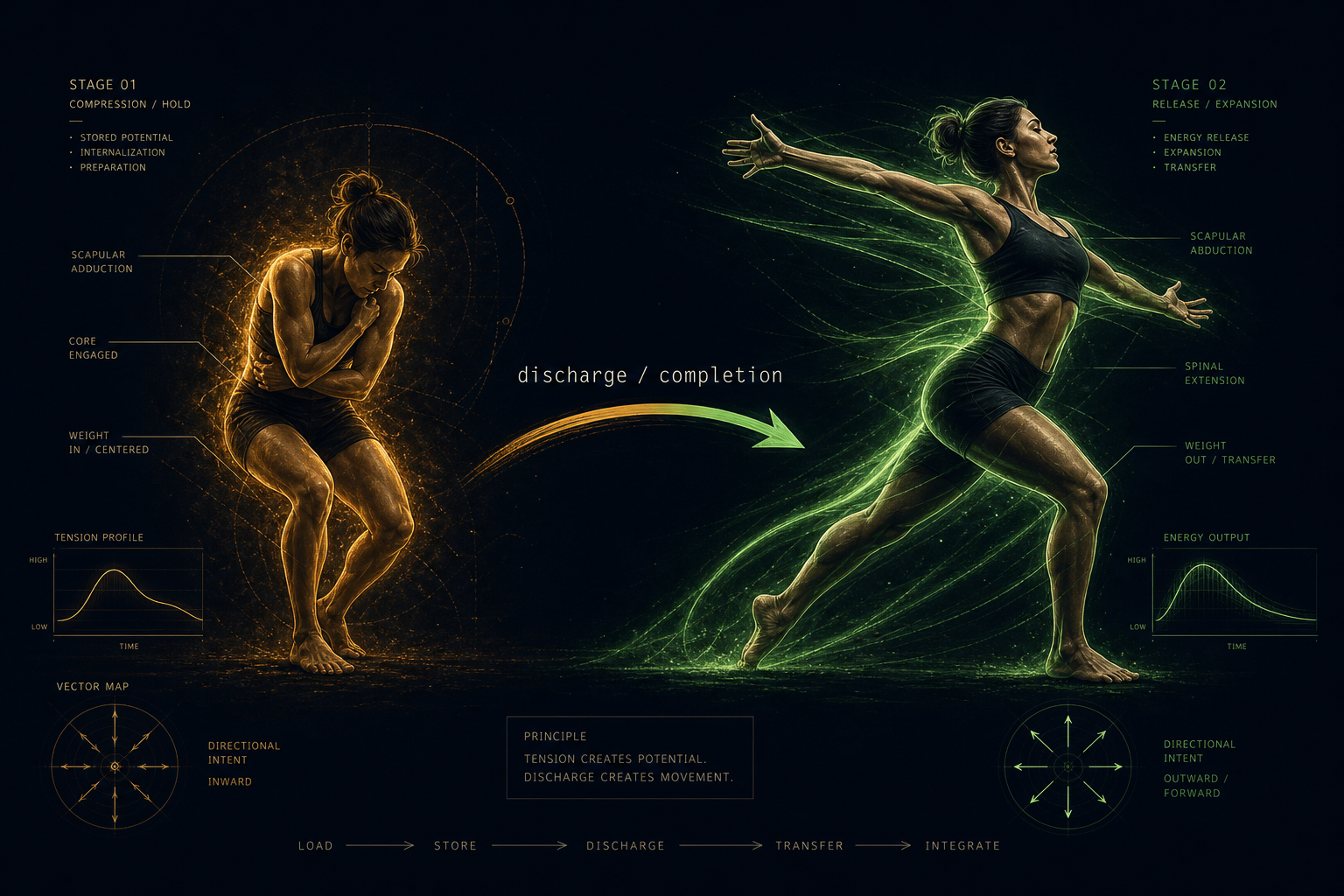
When a nervous system activation occurs — fear, anger, longing, grief — the body mobilizes for action. In modern life, that action rarely happens. The activation is suppressed or deferred. The incomplete cycle is stored in the body as tension, holding patterns, chronic bracing.
Movement completes cycles. Not because it resolves the external situation, but because it gives the activation somewhere to go. The trembling after fear, the shaking after cold, the crying after grief — these are all forms of physical discharge that complete a cycle that the mind alone cannot close.
Improvisational movement, particularly when it follows the actual quality of what the body wants to express (not imposed choreography, but listening to the impulse), is one of the most reliable ways to find and complete held cycles. This is the biological basis of somatic therapy, dance/movement therapy, and trauma-informed movement practices.
A Note on Ecstatic and Structureless Movement
Free-form, unstructured movement (sometimes called ecstatic dance) has real value — particularly for emotional release and accessing states that rigid structure blocks. But structure matters for neuroplasticity.
The brain changes most in response to learning — acquiring new patterns, solving new coordination problems, adapting to new vocabularies. Doing the same free movement repeatedly, without a framework that challenges the nervous system to acquire new patterns, produces less plasticity than structured learning.
This is why studying multiple traditions matters. Not to master all of them, but because each tradition asks the nervous system to organize itself differently. Ballet’s emphasis on turnout and verticality, Laban’s use of effort variation, martial arts’ explosive precision, yoga’s held isometric weight — each one carves different grooves, builds different connections, and ultimately contributes to a more integrated, more plastic nervous system.
For the Non-Dancer
You don’t need a dance background to benefit from integrated movement. The principle is simple:
- Move your whole body, not isolated parts
- Vary the quality — sometimes slow, sometimes explosive; sometimes heavy, sometimes light
- Learn new patterns — take a class, follow a video, try something that challenges your coordination
- Move to express, not just to exercise — let the body lead sometimes, follow the impulse
This doesn’t require years of training. It requires intention and variety. The brain responds to novelty and challenge — give it both, with your whole body, and the plasticity follows.