The Science
Downshiftr is not a wellness app with a biology aesthetic. The biology is the actual mechanism. Everything in the app is built around what the nervous system is, how it changes, and what it needs to do that work.
This page introduces the four scientific foundations the app is built on. Each one has a dedicated page with the full depth — the purpose here is to show how they connect.
Neuroplasticity
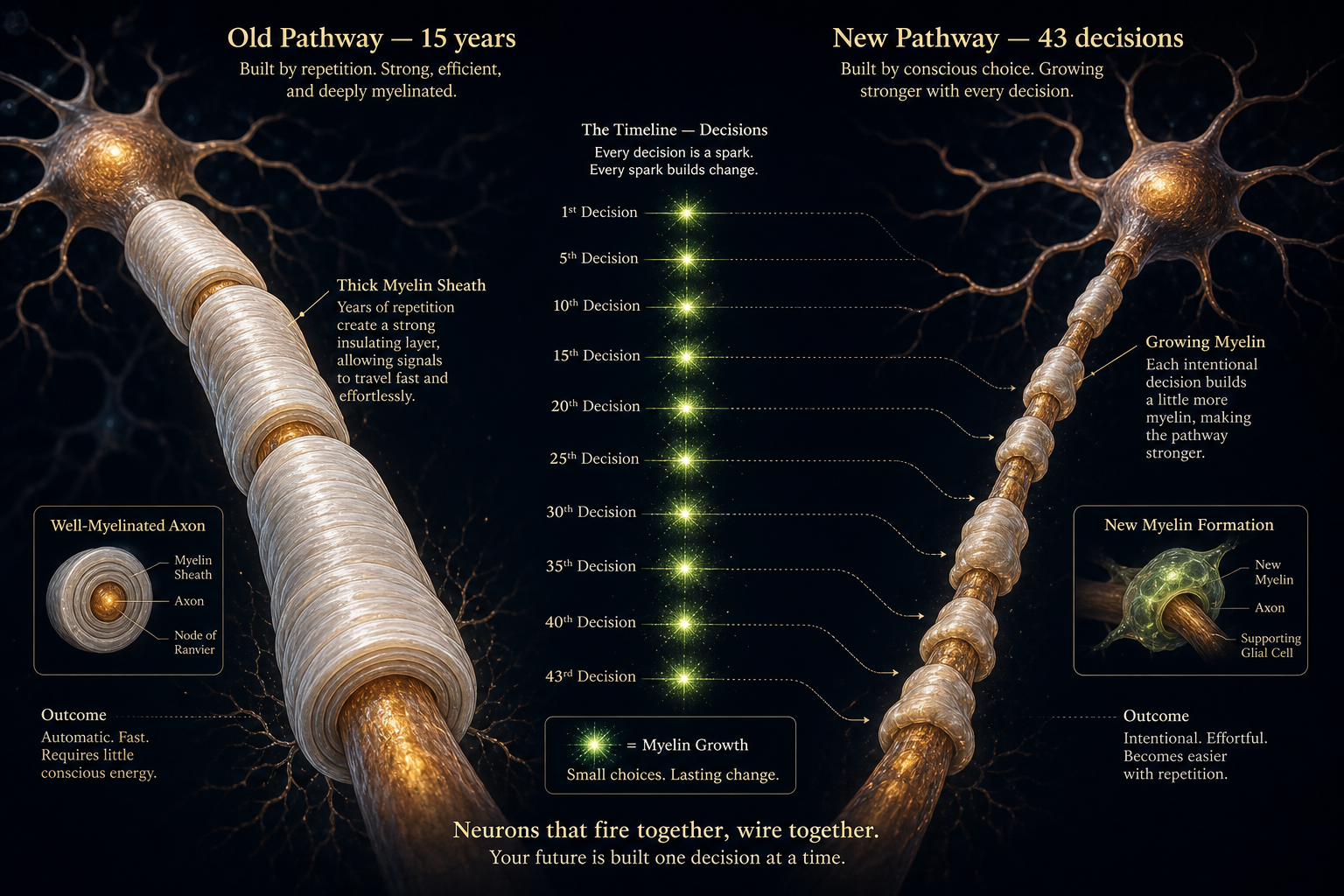
The brain changes through repetition. Not through insight, not through intention — through repeated activation of new pathways. Each time you make a different choice at the trigger moment, you activate the new pathway. Each activation slightly strengthens the connections. Myelin thickens around the axons. The pathway becomes incrementally faster, easier, more automatic.
This is not metaphor. It is the literal mechanism of learning.
The problem is that it doesn’t feel like change from the inside. The old pathway feels like yourself. The new pathway feels like effort. The brain interprets that effort as wrongness, not progress. And so most people stop before the new pathway is strong enough to run on its own.
Downshiftr addresses this gap by making the accumulation visible. Every decision is evidence.
Polyvagal Theory
Stephen Porges’ polyvagal theory describes the autonomic nervous system not as a simple on/off dial but as three hierarchical zones, each a distinct biological configuration with its own physiology, behavior, and perception.
Why this matters for habit change: you cannot lay down new neural pathways from outside the window of tolerance. In sympathetic flooding (fight/flight), pattern execution overrides deliberate choice. In dorsal vagal shutdown (freeze/collapse), the cortex is partially offline. Only in the ventral vagal zone — or close enough to it — does the habit layer become writable.
This is why the app always regulates before it asks for a decision. And it’s why the digital twin shows the vagus nerve, not just the brain — the vagus is the gate between the metabolic layer and the habit layer.
Understanding polyvagal theory also removes a layer of self-blame. When you freeze in the face of a trigger, it’s not weakness. It’s dorsal vagal — your oldest defense system doing exactly what it evolved to do. When you obsessively reach for connection, it’s not neediness. It’s separation panic running through sympathetic activation. These are biological responses, not character flaws.
→ Full depth: Polyvagal Theory — the three zones, the 80% afferent fact, nervous system cycles, the window of tolerance, how to move between zones.
The Four Panic Systems
Classic attachment theory described two styles: anxious and avoidant. These are useful but incomplete — they describe the direction of the response, not the threat being sensed.
There are four distinct biological alarm systems, each responding to a different core threat:
- Separation panic — loss of connection or belonging
- Engulfment panic — loss of autonomy or self
- Evaluation panic — loss of status, worth, or acceptance
- Chaos panic — loss of predictability or ground
Each alarm has two characteristic reactions — approach (anxious pattern) and withdraw (avoidant pattern). Each requires a different regulation approach because the underlying threat is different. Treating them identically — as a generic “panic” — misses why each one fires and what it needs.

→ Full depth: The Panic Button — all four types with approach and withdraw reactions, regulation sequences by polyvagal zone, the zoom-out tool, and the path to secure attachment.
The State Model
The nervous system doesn’t move through infinite unique configurations. It clusters into recognizable regions — attractors in an 8-dimensional space defined by Arousal, Valence, Approach/Avoidance, Agency, Bandwidth, Social Orientation, Temporal Horizon, and Meaning Load.
These 8 dimensions are not abstract. Each one is a measurable aspect of nervous system function with distinct biological structures. And together they define a manifold with 22 named attractor regions — the states the nervous system tends to inhabit and return to.
The state model is what makes the app diagnostically precise. When a trigger fires, you’re not just “stressed” or “anxious.” You’re in a specific configuration with specific coordinates. That configuration determines which tools can work, which pathways are accessible, and what the pattern looks like over time.
→ Full depth: The 8 Dimensions — the biology behind each axis. 22 Nervous System States — the attractor regions, with dimensional coordinates and spider charts.
Reward Chemistry
The state model describes where the nervous system is. Reward chemistry explains why it keeps returning to the same places.
Dopamine encodes prediction error — the gap between expected and actual reward. Not pleasure itself, but the anticipation of and motivation toward reward. The nervous system has learned, through thousands of repetitions, which states and which behaviors predict reward. That learning is not conscious. It is written in the dopaminergic and oxytocinergic weightings of neural connections, operating automatically below awareness.
This is why patterns persist even when they hurt. Not because the person is weak or irrational. Because the brain is efficiently executing the strategy its history says is most likely to produce relief. Changing the pattern means giving the brain new data — not through argument or insight, but through embodied experience repeated enough times to shift the weightings.
→ Full depth: Dopamine & Oxytocin — how reward maps are written by early experience, why unhealthy patterns self-reinforce, and the biological mechanism by which they change.
The Metabolic Layer
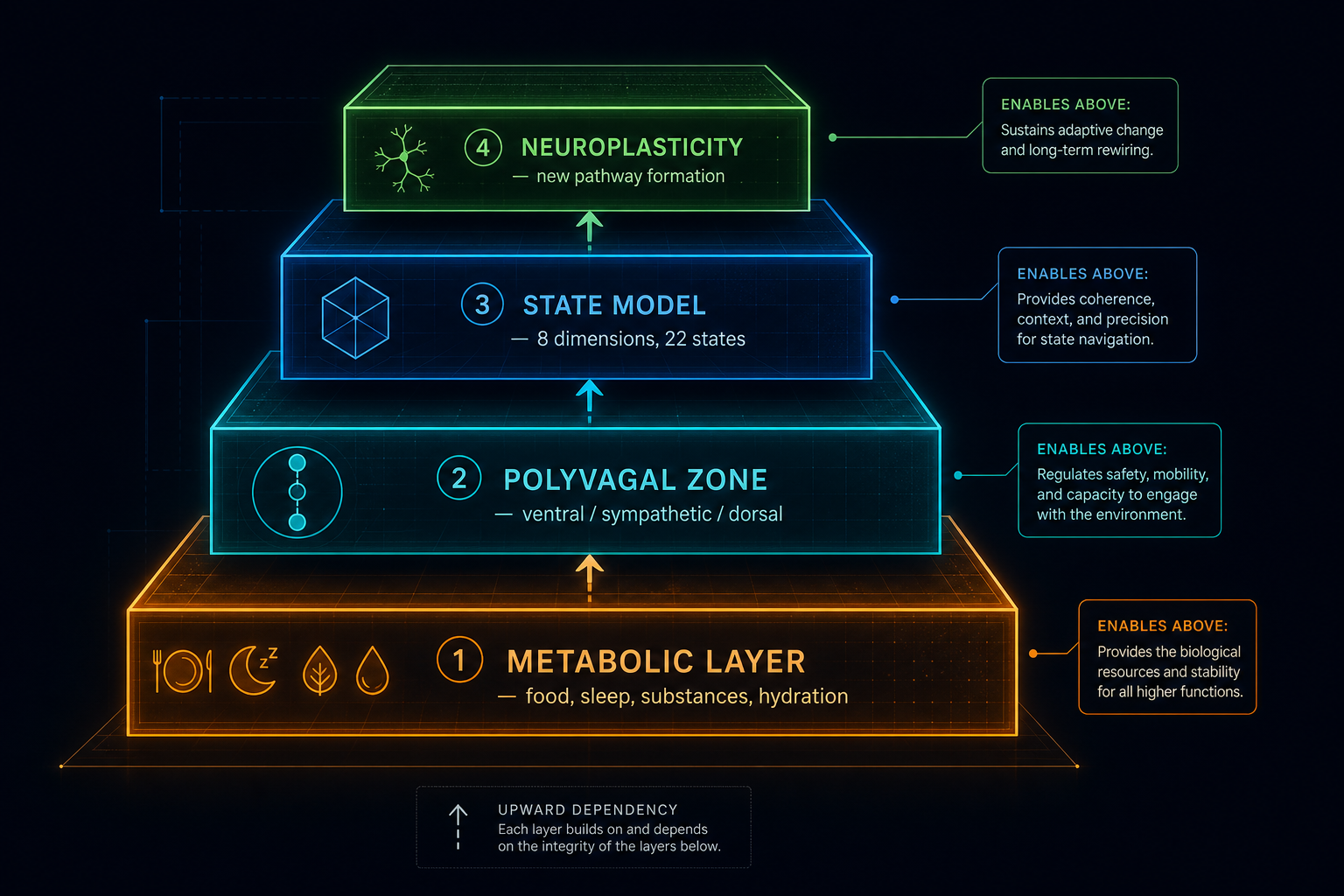
The nervous system runs on biology. Its capacity to regulate, to make new-pathway choices, to access ventral vagal states — all of this depends on the metabolic substrate being present.
Hunger, sleep debt, substance interference, and dehydration all directly constrain which polyvagal zone is accessible. A depleted system defaults toward dorsal vagal regardless of intention. A well-fueled system has more range, recovers faster, and is able to stay within the window of tolerance under conditions that would otherwise push it out.
This is not background wellness advice. It is the most direct lever available in the first weeks of habit change — because the metabolic layer is faster to shift than the neural pathways above it.
→ Full depth: Metabolic Layer — the three-phase progression, salt and fat as the first regulation tools, why substances suppress nervous system cycles, and the difference between metabolic support and willpower.
How the Layers Connect
These four systems are not parallel features. They are a stack, each layer a prerequisite for the one above it.
Metabolism determines what polyvagal zone is accessible at all. A depleted system cannot access ventral vagal states regardless of what you ask of it.
Polyvagal zone determines whether the habit layer is online. In dorsal shutdown or sympathetic flooding, the cortex is not available for deliberate new-pathway choices.
State (the 8-dimensional configuration within a zone) determines which specific tools can work, which regulation sequence fits, and what the pattern looks like over time.
Neuroplasticity is what happens when the layers below it are in the right configuration and a new-pathway choice gets made: the pathway physically strengthens. One more small increment of the groove turning green.
The app’s design follows this logic. When you’re severely depleted, it surfaces metabolic interventions before habit decisions. When you’re outside the window of tolerance, it regulates before it asks for choices. When you’re in baseline, it presents the habit pair. At each layer, the right intervention depends on what the layer below is doing.