The State Model
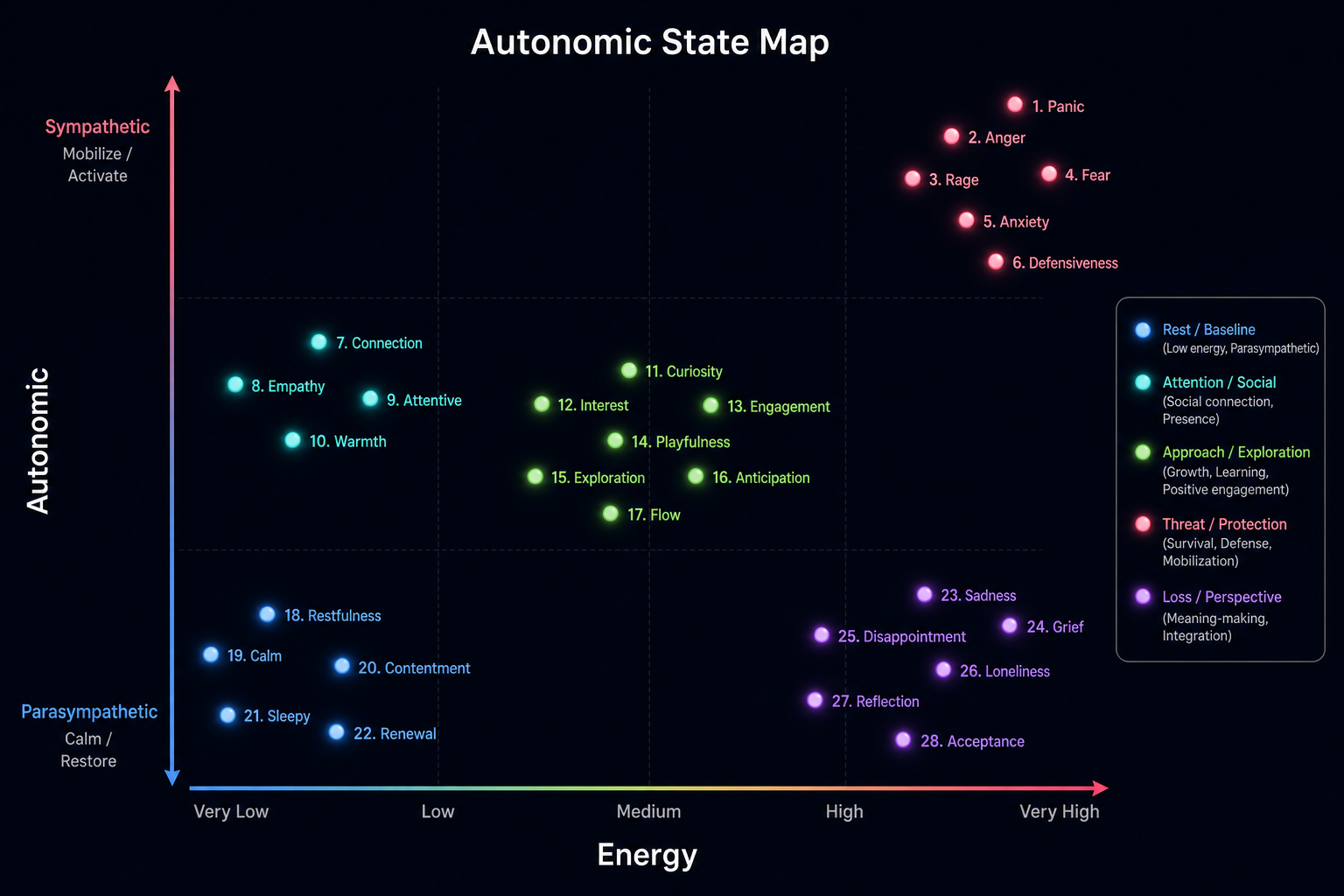
22 Nervous System States
The nervous system doesn't move through infinite unique configurations. It clusters into recognizable regions — stable attractor states with consistent physiology, behavior, and dimensional coordinates.
Each state below includes its approximate position in the 8-dimensional manifold (see The 8 Dimensions). These are ranges, not exact values — the purpose is to show how states are geometrically distinct regions in the same space, not arbitrary categories.
Dimension key (1–7 scale, low→high):
Rest & Baseline
Foundational availability states. These determine what other states are reachable.
Thresholded maintenance mode. Exits best via time, not willpower.
Safety/settling state. Warm, slow, permissive. Restores capacity.
Low drive and low mobilization. Structure helps more than freedom.
Neutral capability. Routines assume this state. Most habit decisions happen here.
Airlock state after sleep, intense emotion, or freeze. Re-anchors agency and context.
Attention & Social Safety
States that increase agency, focus, and connection without requiring high arousal.
Narrow, absorbed attention. Works when pressure stays low. Best state for executing new habits.
Ventral-vagal social safety. Open, expressive, connected. Separation panic resolves here.
Grounded firmness. "No" without heat. Exit point for engulfment panic that doesn't collapse.
Approach & Exploration
Healthy dopamine axis: curiosity → play → desire → flow.
Interest without compulsion. Learning-oriented. Ideal state for habit pair setup.
Low-stakes novelty. Humor, looseness, rule-bending. Dopamine without threat.
Directional dopamine pull. Can be hijacked by old pathways — the question is what you are seeking toward.
Action without self-monitoring. Cannot be forced; conditions can be created.
Threat & Protection
Pressure, vigilance, fight/freeze. Useful for survival, costly to linger in.
Urgency and optimization. Productive but costly — overuse leads to burnout.
Scanning and rumination. Thinking amplifies it. Somatic regulation must precede any reflection.
Heat and certainty. Useful but needs a clean exit and physical discharge.
Dorsal vagal dominance. Numb, distant. Often mistaken for laziness. Movement before words.
Loss & Perspective
States that process loss or reset priors. Often misclassified as pathology.
Loss processing without collapse. Connection-compatible sadness. Valid — witness it, don't fix it.
Vastness and reset. Priorities dissolve briefly. The zoom-out tool aims at a mild version of this.
Completion & Integration
Loop-closing states that prevent compulsive chasing and restore coherence.
"Enough" signal after reward. Settles loops and reduces compulsive chasing.
No urgency, no narrative. "This just is" calmness. Target state after zoom-out.
Coherence and insight. Reflection belongs here — not inside threat states.
Reading the Coordinates
The coordinate values above are approximate centers of each state's region in the manifold — not hard boundaries. Real nervous system states blur at the edges and transition continuously.
A few things to notice:
- Anxiety (14) vs Flow (12) — both have high Arousal and narrow Bandwidth, but completely opposite Valence (2 vs 6) and Agency (2 vs 6). Same energy, opposite experience.
- Freeze (16) vs Parasympathetic Rest (2) — both look "calm" from the outside but have opposite Valence (2 vs 6) and Agency (1 vs 4). Shutdown is not rest.
- Grief (17) vs Depression (3) — both low arousal and low valence, but Grief has much higher Bandwidth (5 vs 3) and Meaning (6 vs 4). Grief is an open, processing state; depression is a collapsed one.
- SEEKING (11) vs Anxiety (14) — nearly identical Arousal (6 vs 7) and Bandwidth (3 vs 2), but completely opposite Valence (6 vs 2) and Approach (7 vs 2). The nervous system energy is similar; the direction is opposite.
These distinctions matter for regulation. You cannot treat SEEKING and Anxiety the same way just because they both feel intense. The dimensional coordinates tell you which intervention makes sense.