The State Model
The 8-dimensional manifold describes the space of human experience. The 22 states describe the regions that nervous systems tend to cluster in. But neither of these explains why your particular nervous system inhabits the specific regions it does — why you tend toward anxiety rather than freeze, toward separation panic rather than engulfment panic, toward SEEKING rather than rest.
The answer is reward chemistry. And the two most important systems are dopamine and oxytocin.
Dopamine: The Pursuit Signal
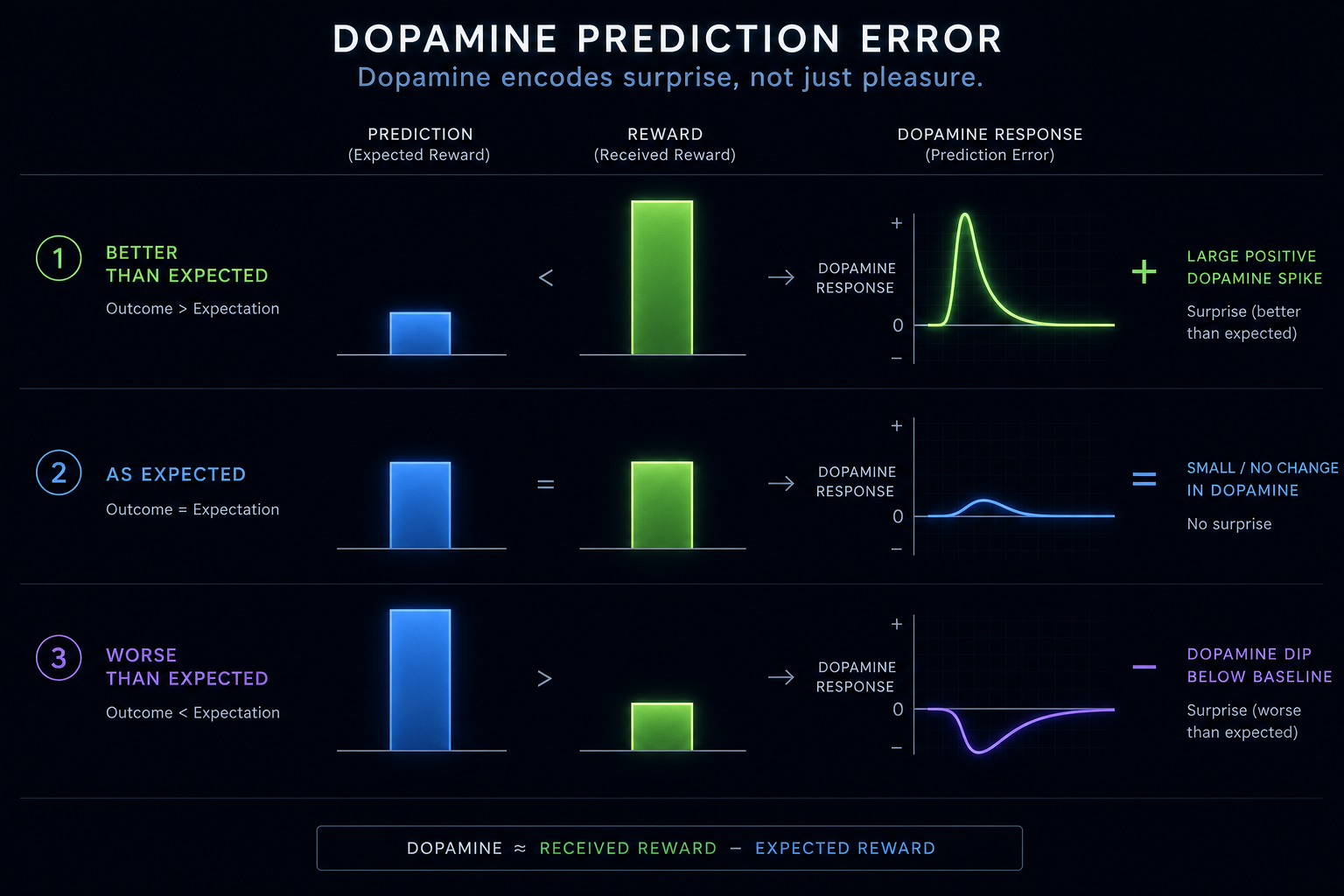
Dopamine is routinely described as the “pleasure chemical.” This is wrong, or at least incomplete. Dopamine doesn’t primarily signal pleasure. It signals anticipation, prediction, and the value of pursuing.
More precisely: dopamine encodes the difference between predicted reward and actual reward. When something is better than expected, dopamine fires strongly. When it matches expectation, less so. When it’s worse, dopamine drops below baseline — producing the aversive feeling of disappointment.
This is why dopamine is the mechanism behind:
- Habit formation (the prediction-reward loop)
- Addiction (substances hijack the prediction signal, making themselves appear more valuable than they are)
- Anticipatory anxiety (the prediction system running threat simulations)
- The appeal of risk (high variance = occasional strong dopamine signal)
- Compulsive behavior (the pursuit itself, not the outcome, becomes the reward)
The Biology
- Ventral tegmental area (VTA) — the primary source of dopamine in the mesolimbic system; projects to nucleus accumbens (reward), prefrontal cortex (executive function), and amygdala (emotional learning)
- Nucleus accumbens (ventral striatum) — the core reward hub; dopamine here encodes wanting and approach motivation
- Prefrontal cortex — dopamine here supports working memory, planning, and the ability to pursue delayed rewards over immediate ones
- Dorsal striatum — dopamine-driven habit formation; when a behavior is repeated enough, it moves from deliberate (PFC) to automatic (striatum)
- Substantia nigra — dopaminergic pathway for motor control and habit execution
What This Means for State Patterns
Your nervous system has learned, through thousands of experiences, which states predict reward. Not conscious reward — biological reward. Dopamine signals.
If early in life, hypervigilance (Anxiety, State 14) was reliably followed by connection (when you sensed danger and called out, someone came), then high arousal + scanning + pursuit became dopamine-associated. The nervous system learned to seek that state, even when it’s costly.
If withdrawal (Freeze, State 16) was reliably followed by safety (when you went quiet, the threatening adult left), then low arousal + low approach became associated with relief. The nervous system learned to produce that state under pressure, even when connection would serve better.
This is not pathology. This is learning. The nervous system optimized for the environment it was actually in.
Oxytocin: The Bonding Signal
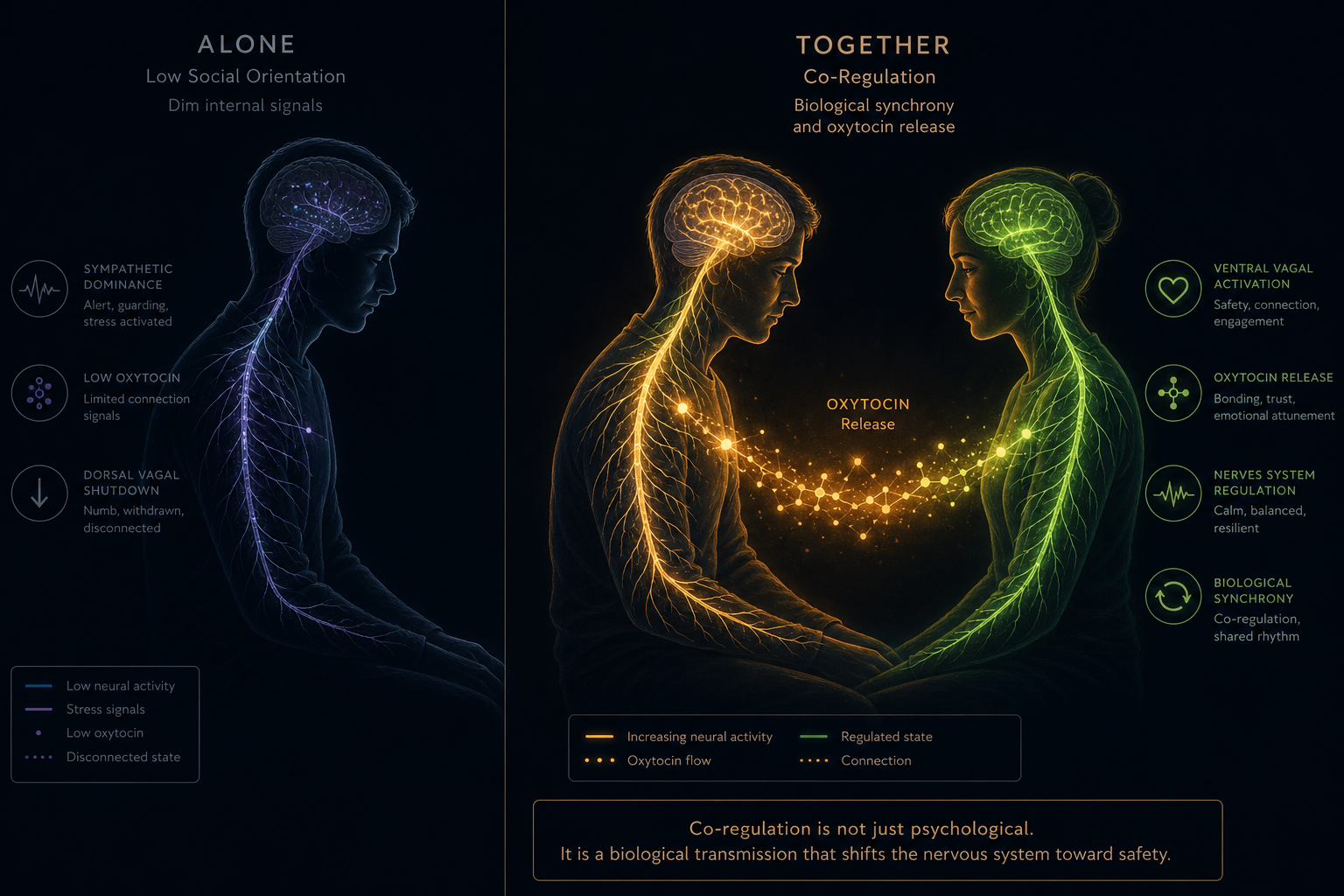
Oxytocin is often called the “love hormone,” which is both right and incomplete. More precisely, oxytocin increases social salience — it makes other people matter more, sharpens attention to their cues, and produces feelings of trust and affiliation.
It does not, by itself, produce positive feelings. It amplifies whatever social context is present. In a safe relationship, it produces warmth and connection. In an unsafe one, it can amplify anxiety, possessiveness, or trauma bonding.
Oxytocin is released by:
- Physical touch (especially sustained contact)
- Eye contact with a trusted person
- Synchronized movement with others (dancing, rowing, marching)
- Breastfeeding and birth
- Orgasm
- Shared laughter
- Being witnessed in distress by someone who remains regulated
The last one is important: co-regulation — being with a regulated nervous system while your own is dysregulated — releases oxytocin and drives the social engagement system (ventral vagal) toward safety. This is why human presence is one of the most powerful regulation tools, and why isolation is so corrosive to nervous system health.
The Biology
- Hypothalamus — produces oxytocin; paraventricular nucleus is the primary production site
- Posterior pituitary — releases oxytocin into the bloodstream as a hormone
- Brainstem and spinal cord — also release oxytocin as a neurotransmitter, directly modulating the vagal circuit
- Vagus nerve (ventral vagal) — oxytocin enhances ventral vagal tone; the social engagement system and oxytocin are tightly coupled
- Amygdala — oxytocin modulates amygdala reactivity; can reduce fear response toward trusted others
- Nucleus accumbens — oxytocin interacts with dopamine here to produce the reward of social bonding
How Life Experience Writes the Reward Map
At birth, the nervous system has no learned dopamine or oxytocin associations. Over the first years of life, through thousands of experiences of threat, relief, connection, and loss, it builds a map: which states are followed by reward, which by punishment, which by nothing.
This map is written implicitly — not in words, not in conscious memory, but in the dopaminergic and oxytocinergic weightings of neural connections. It operates automatically, below awareness.
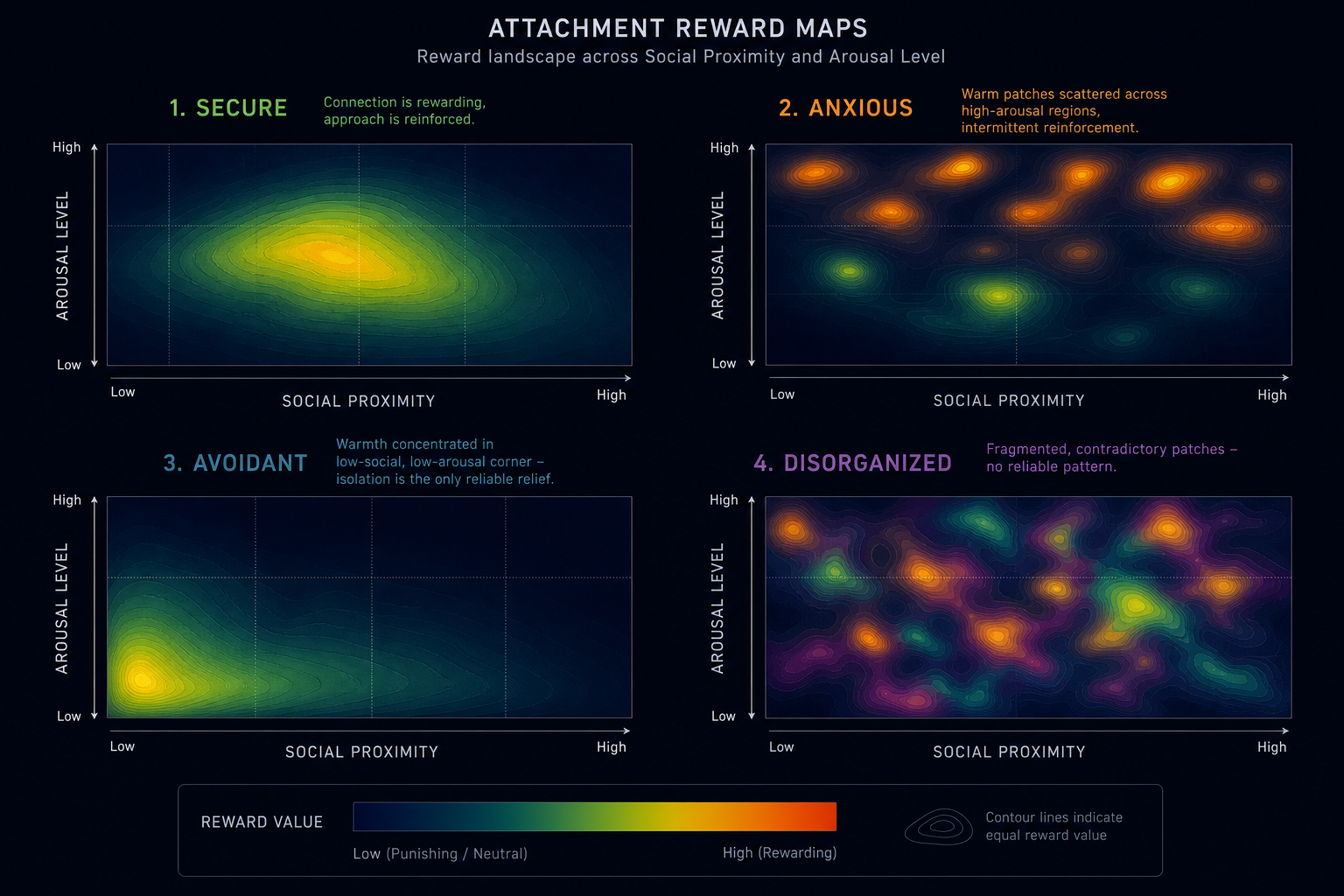
Secure early attachment produces a map where:
- Social engagement is reliably rewarding (oxytocin + dopamine)
- Distress is reliably followed by relief through connection (co-regulation)
- The nervous system learns: activation → express → connection → resolution
Anxious early attachment produces a map where:
- Connection is intermittently rewarding (the unpredictable schedule produces stronger dopamine via variable reinforcement)
- Hypervigilance is associated with occasionally getting it right (pursuit was sometimes rewarded)
- The nervous system learns: activation → escalate pursuit → occasional connection → temporary relief (but the underlying loop never closes)
Avoidant early attachment produces a map where:
- Connection is associated with threat or unavailability (approach was not rewarded or was punished)
- Self-regulation is the only reliable pathway to relief
- The nervous system learns: activation → suppress → isolation → the aversive feeling eventually fades
Disorganized/chaotic early attachment produces a map where:
- The source of threat and the source of comfort are the same person
- Neither approach nor avoidance resolves the activation
- The nervous system oscillates between strategies, never finding a reliable pattern
Why We Replicate Unhealthy Patterns
The reward map created in early life is not the only factor — but it is the baseline. And it has a self-reinforcing quality: the states we learned to associate with reward are the states we keep returning to, which produces more of the same data, which reinforces the map.
An anxious nervous system that learned pursuit produces occasional connection will keep pursuing — because the variable reinforcement schedule is one of the most potent dopamine patterns known. Slot machines use the same mechanism. The reward doesn’t have to be reliable to maintain the behavior; it just has to be unpredictable enough to sustain hope.
An avoidant nervous system that learned isolation produces safety will keep isolating — because the immediate relief of reducing social arousal is a reliable, immediate negative reinforcement. It works every time, in the short term. The cost is paid over months and years, not moments.
The nervous system is not making mistakes. It is executing the strategy that its history says is most likely to produce relief or reward. The map is the problem — not the person following it.
How the Map Changes
The reward map is not fixed. It is plastic — for the same reason habit pathways are plastic: repeated activation with new outcomes.
New data changes the map:
Every time social engagement produces genuine safety (oxytocin + regulated outcome), the map updates slightly toward: connection is safe.
Every time staying with anxiety without pursuing or withdrawing produces eventual subsidence (the panic decays without resolution), the map updates slightly toward: I don’t need to act on this signal immediately.
Every time a new, healthy dopamine source (social activity, skill acquisition, movement) produces genuine reward, the map updates toward: this is worth pursuing.
None of these updates happen through insight. They happen through embodied experience, repeated enough times to shift the weightings.
This is why Downshiftr tracks decisions over time. Each logged decision is a data point. Each data point is a small nudge to the map. The brain map turning green is not a metaphor for “good job.” It is a representation of a real shift in the neural weighting of that pathway — driven by real oxytocin and dopamine signals produced by real choices made in real moments.
The map changes because you lived differently. That’s the only mechanism that works.