The Panic Button
The Panic Button is not a crisis line. It’s a biological interrupt.
It catches you at the moment when a trigger has fired and the nervous system is running a pattern — before you’ve acted. Its job is to move you from limbic reactivity back to prefrontal access. Not through motivation. Through regulation.
Regulation first. Then choice.
The app does not push, shame, or cheer. It witnesses, names, and restores.
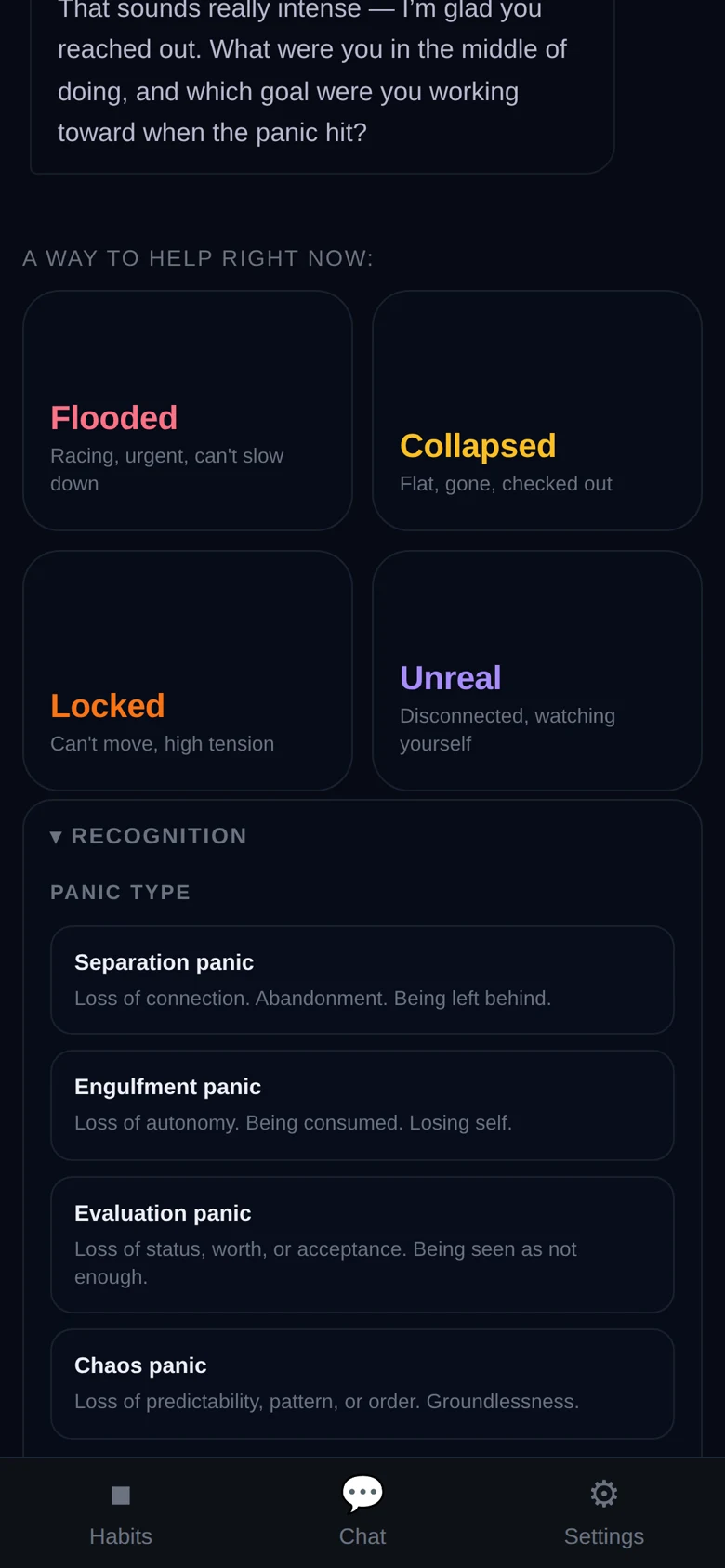
The flow opens with the body, because when the alarm is loud the reading brain is offline. A press-and-hold breathing guide — inhale while pressing, exhale on release — stimulates the vagus nerve before any words are exchanged:
The Four Panic Types
The first thing the Panic Button does is help you identify which alarm system fired. Not with a quiz — with felt-sense recognition.
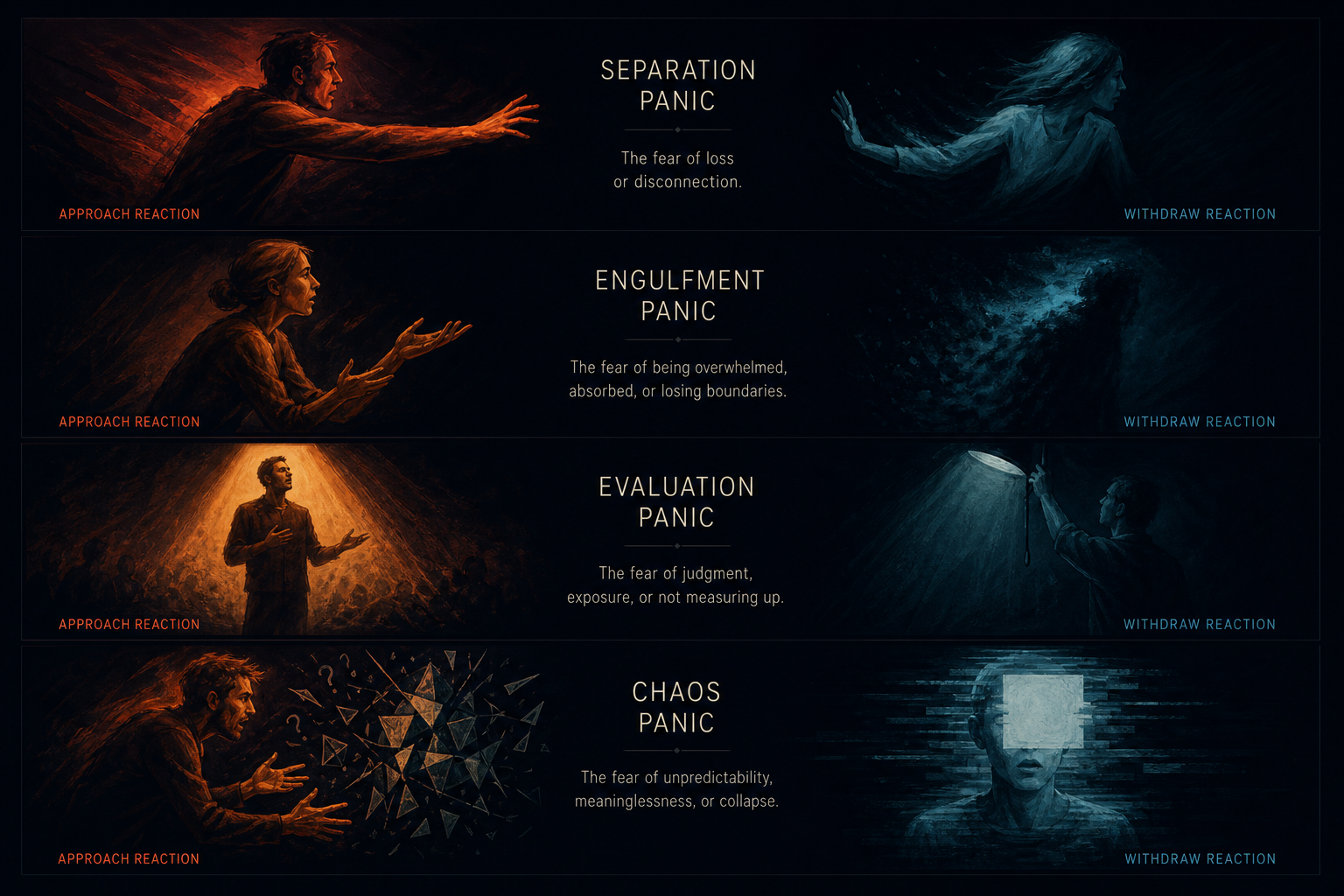
Each panic type has two characteristic default reactions, reflecting the two directions a nervous system can move under threat: approach (anxious attachment pattern) and withdraw (avoidant attachment pattern).
Separation Panic
The alarm: Loss of connection. Abandonment. Being left behind.
Body signal: Chest tightness, urgency, restlessness, difficulty sitting still.
| Pattern | Default reaction |
|---|---|
| Approach (anxious) | Pursue — call, text, explain, escalate contact, seek reassurance, demand a response |
| Withdraw (avoidant) | Preemptive shutdown — go cold, emotionally disappear before the abandonment can happen; beat them to it |
“They went quiet and I need to know why right now” — or — “I’m going to pull back before this gets worse.”
Engulfment Panic
The alarm: Loss of autonomy. Being consumed. Losing self.
Body signal: Sudden flatness, desire to disappear, irritability at closeness, numbness.
| Pattern | Default reaction |
|---|---|
| Approach (anxious) | Negotiate while staying close — explain why you need space, manage the relationship through words, attempt to control the dynamic without actually leaving |
| Withdraw (avoidant) | Full withdrawal — go silent, minimize contact to near-zero, become functionally absent |
“I need to make you understand I need space” — or — “I just need to disappear.”
Evaluation Panic
The alarm: Loss of status, worth, or acceptance. Being seen as not enough.
Body signal: Performance anxiety, hypervigilance to others’ reactions, compulsive self-monitoring.
| Pattern | Default reaction |
|---|---|
| Approach (anxious) | Perform — over-explain, people-please, optimize self-presentation, pre-emptively defend against the judgment you anticipate |
| Withdraw (avoidant) | Disengage — don’t try, go cold, become dismissive of the evaluator or the stakes (“I don’t care anyway”) |
“I need to fix how this looks before they decide what it means” — or — “None of this matters to me.”
Chaos Panic
The alarm: Loss of predictability, pattern, or order. Groundlessness.
Body signal: Disorientation, rigidity, compulsive need to plan or test, or total freeze.
| Pattern | Default reaction |
|---|---|
| Approach (anxious) | Demand clarity — escalate questions, test repeatedly, create rules and ask for constant confirmation that the rules are holding |
| Withdraw (avoidant) | Impose structure unilaterally or freeze entirely — either enforce rigid control to restore predictability, or disengage from the chaotic situation completely |
“I need to understand exactly what is happening and what will happen next” — or — “I can’t deal with this.”
Disorganized and Secure
Disorganized attachment (sometimes called chaotic) can produce both reactions simultaneously or oscillate rapidly between them — approach and withdraw triggered by the same alarm. This is the most dysregulating pattern. The Panic Button asks the user to identify which direction they’re currently moving — approach or withdraw — as a way of simplifying the chaos to one choice, one direction, one step toward either anxious or avoidant (which can each then move toward secure).
Secure attachment is not the absence of panic. It is the ability to feel the panic — fully, biologically — and let it subside without immediately resolving the source.
The alarm fires. The body activates. And the person does not pursue, perform, withdraw, or control. They breathe. They wait. They let the wave pass.
Over time, with repetition, the nervous system learns that the alarm does not require immediate action to survive. The intensity decreases. The recovery time shortens. The pattern loses its grip.
This is not about becoming someone who doesn’t feel things. It is about becoming someone who can feel things without being run by them.
Secure attachment is a skill built through repeated tolerance of unresolved biological panic. Not through resolution of the source — through tolerance of the feeling while the source remains temporarily open.
Surface the Default Movement
Once the panic type is identified, the app tells you what your system is about to do — before you do it.
“Your default move right now looks like pursue. That’s not weakness. It’s a protection strategy your system learned. It worked once. We’re just going to pause before you run it.”
This creates a half-second of space between the impulse and the action. That space is where choice lives.
State Snapshot
Before regulation begins: a quick 8-axis dimensional state capture. 8 sliders, under 60 seconds. The AI reads the resulting polygon, identifies which of the 22 named nervous system states you’re closest to, and determines your polyvagal zone — whether you’re in sympathetic activation (flooded, mobilized), dorsal vagal (collapsed, offline), or somewhere within the window of tolerance.
This identification determines the entire regulation sequence. The same panic type in two different polyvagal zones requires opposite first interventions: flooding needs discharge; shutdown needs gentle activation. Applying the wrong tool to the wrong zone makes both worse.
The same snapshot is captured post-regulation, so you can see what actually moved — and by how much.
Regulation
Based on panic type, polyvagal zone, and dimensional state, the app sequences regulation tools. The goal is always the same: move from limbic reactivity to prefrontal access without suppressing the activation. Let it complete, not defer.
The tools are organized by zone because the wrong tool at the wrong moment makes things worse. The app sequences them in order — somatic first, cognitive only once the window of tolerance is restored.
Sympathetic Zone — flooding, mobilized, fight/flight active
Activation is present and high. These tools work with the energy — discharging it, redirecting it, or interrupting the loop through the body before the cortex can re-engage:
- Extended exhale — the most direct sympathetic brake. Lengthening the exhale activates the vagal brake via respiratory sinus arrhythmia. Ratio matters: inhale 4 counts, exhale 6–8.
- Humming / gargling — direct vagal stimulation through the larynx and pharynx. Works even at high activation because it bypasses cognitive processing entirely.
- Movement — physical discharge of mobilization energy. The sympathetic activation cycle has a natural motor completion; movement provides it.
- 5-4-3-2-1 grounding — forces the perceptual field open by activating multiple sensory channels simultaneously. Counteracts tunnel vision.
Dorsal Zone — shutdown, freeze, collapsed
The system is not flooded — it is offline. Calm-down tools make this worse. The system needs gentle activation to begin ascending through sympathetic toward ventral:
- Movement (gentle) — initiates the ascent. Not intense exercise; walking, shaking out limbs, changing posture. Starting is the entire task — not performing well, not finishing.
- 5-4-3-2-1 grounding — sensory re-engagement with the present environment. Reconnects the system to current reality from below.
- Humming — vagal stimulation that doesn’t require energy the system doesn’t have.
- Body scan — gentle interoceptive re-engagement. Finds what’s present without demanding more.
Returning to Ventral — regulation partially complete, cortex coming back online
The system has moved back toward or into the window of tolerance. Cognitive and somatic tools now work together:
- Box breathing — four counts each direction. Rhythm and predictability signal safety to the nervous system; specifically effective for Chaos panic.
- Name the feeling — verbal labeling activates the prefrontal cortex. The first thread of narrative from a regulated state.
- Zoom out — temporal horizon expansion: “This is a moment, not everything.” Accessible only once the temporal dimension has reopened enough to hold a wider view.
- Agency affirmation — three things you control right now, small and concrete. Restores the sense of authorship that panic collapsed.
- Body scan — releases performance-tension, completes the somatic check-in.
The Zoom Out
The most important regulation tool. Not cognitive reframing — a genuine temporal and somatic shift.
- Body anchor. Both feet on the floor. Weight in the chair.
- Now statement. You are in this room. It is this time of day. You are safe in your body right now.
- Time expansion. In one hour, this will have changed. Your nervous system will have moved.
- Relationship to the system. Your alarm fired because it was protecting you. The alarm is not a verdict. It is biology.
- Return agency. You don’t have to decide anything right now. Just breathe for 30 more seconds.
The Choice Point
After regulation, one question:
“You’ve come back to yourself. What do you want to do?”
No celebration. No shame. Either choice is logged. The data builds a picture of patterns over time — which panics resolve into action, which don’t, what state you were in when you made each choice.
The brain map only updates on decisions. But the session itself is always worth something.