The State Model
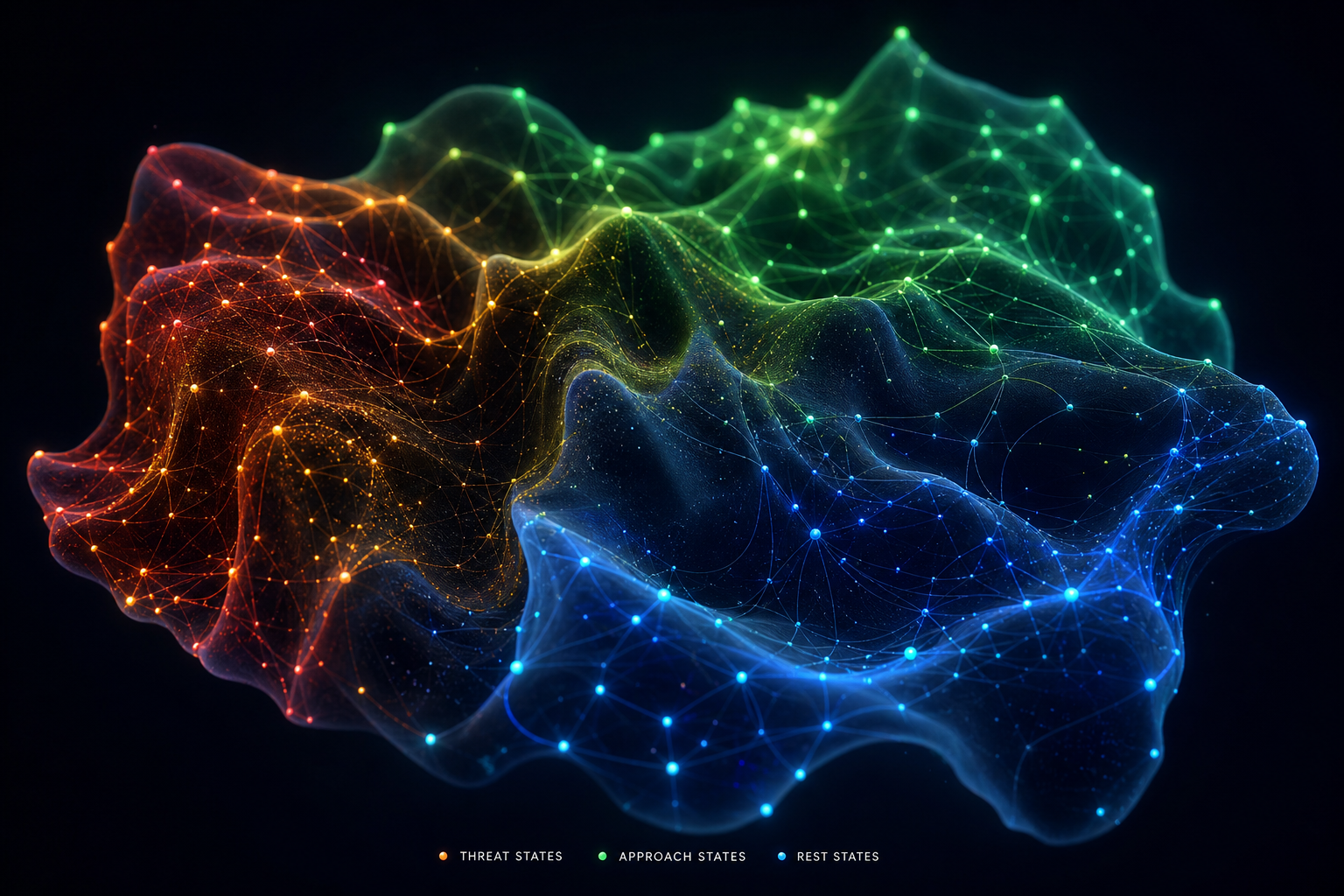
Human experience does not move through infinite unique configurations. It moves through a structured space — a manifold — defined by a small number of independent biological dimensions.
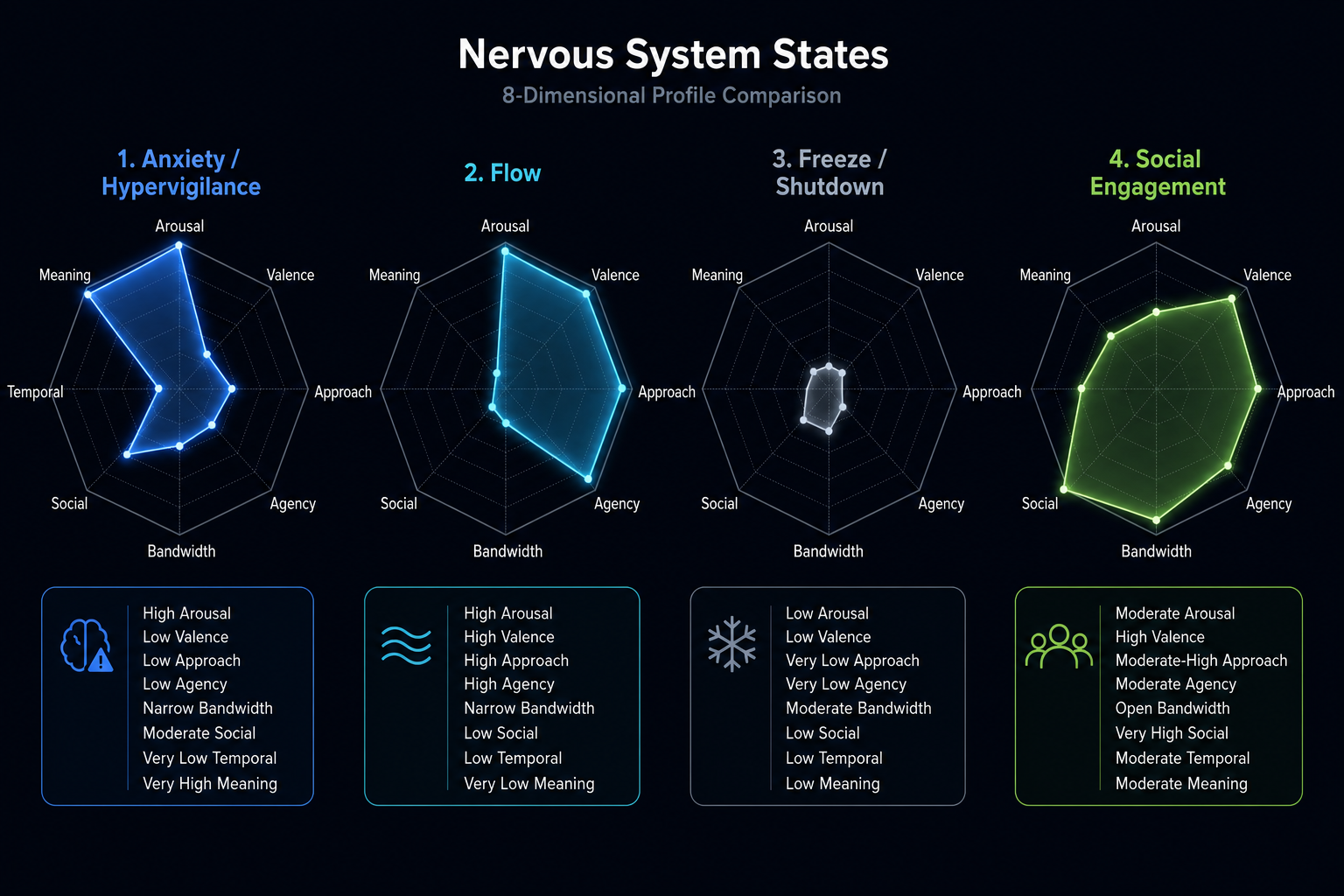
Downshiftr models this space with 8 dimensions. Each dimension is independent: you can be high on one and low on another in any combination. Together, they define a coordinate system where every psychological state is a location.
The 22 named states are not separate categories — they are recognizable regions in this space, configurations the nervous system tends to cluster around. Understanding the dimensions is understanding the space those regions inhabit.
Dimension 1 — Global Arousal
Poles: Depleted ↔ Charged
Scale: 1 (near-sleep) → 7 (peak activation)
What it measures
The overall energy and intensity level available to the system — the gate that determines which other states are even reachable at any given moment.
Biology
- Reticular activating system (RAS) in the brainstem — the master arousal switch, filters sensory input and gates wakefulness
- Locus coeruleus — the brain’s primary norepinephrine hub, projects throughout the cortex; when active, increases arousal and alertness
- Thalamus — the relay station for sensory information; arousal level determines how much signal gets through to cortex
- Adenosine accumulation (sleep pressure) opposes arousal; caffeine blocks adenosine receptors
- Adrenal axis (HPA) — cortisol and adrenaline raise arousal through hormonal signaling
Why it matters
Very low arousal makes most states unreachable — the system is in maintenance mode. Very high arousal risks limbic override (the cortex loses executive control). The regulation sweet spot for most habit decisions is 3–5 on this axis.
Dimension 2 — Valence Orientation
Poles: Threatened ↔ Safe
Scale: 1 (threat dominant) → 7 (reward dominant)
What it measures
Whether experience is being processed as something to move away from or toward — the fundamental push/pull bias of the nervous system at this moment.
Biology
- Amygdala — the threat-detection hub; fires on ambiguous stimuli, social threat, fear memory; when dominant, shifts valence toward aversive
- Nucleus accumbens (ventral striatum) — the reward hub; processes positive anticipation; mesolimbic dopamine pathway activation shifts valence toward appetitive
- Anterior cingulate cortex (ACC) — monitors conflict and salience; helps the brain determine whether a signal is threat or reward
- Insula — interoceptive cortex; translates body signals into felt sense; bad body feeling shifts valence aversive
- Ventromedial prefrontal cortex (vmPFC) — safety signaling; can down-regulate amygdala when it has learned the situation is safe
Why it matters
Valence is independent of arousal. High arousal + aversive valence = anxiety. High arousal + appetitive valence = excitement or SEEKING. Understanding valence separately from energy is essential for correctly identifying what state you’re in.
Dimension 3 — Approach / Avoidance Bias
Poles: Frozen ↔ Moving
Scale: 1 (avoidance dominant) → 7 (approach dominant)
What it measures
Motor and behavioral readiness — whether the nervous system is organized for action toward something or away from (or away from action altogether). Critically: this is independent of valence. You can approach pain (surgery, confrontation). You can avoid pleasure (isolating from things you love). Direction ≠ feel.
Biology
- Behavioral Activation System (BAS) — dopaminergic circuits through the ventral tegmental area (VTA) and striatum; governs approach motivation
- Behavioral Inhibition System (BIS) — septo-hippocampal system, amygdala; activates under conflict or uncertainty; produces avoidance and risk assessment
- Basal ganglia — action selection; determines which motor programs are initiated vs suppressed
- Dorsal striatum — habit execution; when strong habits are triggered, approach/avoidance bias can become near-automatic
- Motor cortex and supplementary motor area (SMA) — preparation and execution of voluntary movement; readiness potential precedes action
Why it matters
When approach bias collapses (dimension goes to 1–2), the person cannot initiate action even when they intellectually want to. This is not lack of motivation — it is biological immobilization. Freeze states, depression, and dorsal vagal shutdown all score very low here.
Dimension 4 — Agency / Control
Poles: Swept Away ↔ In Charge
Scale: 1 (no sense of authorship) → 7 (full sense of agency)
What it measures
The subjective sense of being the author of one’s own actions and experience — whether the self feels like the source of what is happening or the recipient of it.
Biology
- Dorsolateral prefrontal cortex (DLPFC) — executive function, working memory, deliberate control; when active, agency is high
- Anterior cingulate cortex (ACC) — error monitoring, conflict detection, effort regulation; key to the experience of effortful control
- Insula — the sense of being in one’s own body is foundational to agency; poor interoception = low felt agency
- Supplementary motor area (SMA) — the “readiness potential” fires here before voluntary action; damage here produces alien-limb syndrome (actions feel unintentional)
- Default mode network (DMN) suppression — when the task-positive network is active, sense of self as agent increases
Why it matters
Panic states crush agency (dimension → 1). Regulation work — particularly the zoom-out and agency affirmation tools — directly targets this dimension. The goal is not to restore full control but to restore enough agency that choice becomes possible again.
Dimension 5 — Attentional Bandwidth
Poles: Tunneled ↔ Open
Scale: 1 (extreme tunnel vision) → 7 (broad, open awareness)
What it measures
How much of the perceptual field is accessible — the difference between a laser and a lantern. Narrow bandwidth means the threat (or goal) is everything; peripheral awareness collapses.
Biology
- Acetylcholine system — basal forebrain projects to cortex; ACh signals “pay attention here,” modulating what gets processed
- Norepinephrine (locus coeruleus) — at moderate levels broadens attention; at high levels narrows it (threat response)
- Prefrontal cortex gating — top-down attention control; determines what sensory information reaches conscious processing
- Anterior cingulate cortex — allocates attentional resources; detects when current focus is insufficient
- Parietal cortex (inferior and superior) — spatial attention, switching between focused and distributed attention
- Salience network (insula + ACC) — determines what gets flagged as important enough to pull attention
Why it matters
The 5-4-3-2-1 grounding exercise directly targets bandwidth expansion — it forces the perceptual field to widen by activating multiple sensory channels simultaneously. When bandwidth is at 1–2, the person cannot access context, perspective, or other people’s states. Regulation must restore bandwidth before insight or choice become possible.
Dimension 6 — Social Orientation
Poles: Self-Contained ↔ Other-Oriented
Scale: 1 (others not salient) → 7 (other nervous systems dominant in field)
What it measures
How much other people are present in the psychological field — their states, reactions, needs, presence. Not whether you like or dislike them, but whether they are there as salient objects.
Biology
- Oxytocin system — hypothalamus produces, posterior pituitary releases; oxytocin increases social salience, trust, and bonding motivation
- Vagus nerve (ventral vagal branch) — the social engagement system; innervates face, voice, and head turning; active when socially safe and open
- Temporoparietal junction (TPJ) — theory of mind; perspective-taking; activated when thinking about others’ mental states
- Mirror neuron system — motor resonance with others’ actions; basis of empathy and imitation
- Default mode network (social component) — medial PFC is active when thinking about other people
- Fusiform face area — specialized for face processing; social threat sensitizes this system
Why it matters
Separation panic scores very high on this dimension (others are everything). Engulfment panic triggers a rapid drop (others become a threat to be managed). Dorsal vagal shutdown scores very low (others are not salient — not unfriendly, just absent from the field). Restoration of social orientation is a key marker of ventral vagal recovery.
Dimension 7 — Temporal Horizon
Poles: Right Now ↔ Big Picture
Scale: 1 (only immediate moment exists) → 7 (extended past and future are fully present)
What it measures
The time scope of experience — whether the present moment is everything, or whether it is one point in a longer narrative. Highly relevant to impulsivity, panic, and the capacity to wait.
Biology
- Prefrontal cortex (especially ventromedial and orbitofrontal) — future simulation, delay of gratification, temporal integration of value
- Hippocampus — episodic memory and future simulation; the ability to vividly imagine the future requires the same circuitry as remembering the past
- Default mode network — prospection and retrospection; active when mind-wandering through past and future
- Hypothalamic-pituitary axis (HPA) — acute stress collapses temporal horizon; cortisol shifts the brain toward immediate threat response
- Dopamine signaling — steep discounting (preferring immediate reward) vs. patient pursuit of delayed reward depends partly on dopamine receptor density in PFC
Why it matters
Panic compresses temporal horizon to 1–2 (only now matters). The zoom-out regulation tool directly targets this — it expands the temporal field to include “in one hour, this will have changed.” This is not just psychological reframing. It is a genuine shift in how the prefrontal cortex is processing time. That shift is neurobiologically real.
Dimension 8 — Meaning / Narrative Load
Poles: Instrumental ↔ Interpretive
Scale: 1 (pure doing, no story) → 7 (full meaning-making engagement)
What it measures
The degree to which experience is being explained, contextualized, and narrated — as opposed to simply being used instrumentally. The difference between eating (instrumental) and eating while thinking about what your eating habits say about you (interpretive).
Biology
- Default mode network (DMN) — medial prefrontal cortex, posterior cingulate, precuneus, angular gyrus; this network activates when the mind is not task-engaged and begins constructing narratives, self-reference, and meaning
- Language areas — Broca’s area (language production) and Wernicke’s area (language comprehension); when high, experience is being verbally organized
- Anterior cingulate cortex — mediates between narrative and action; high meaning load + high conflict = rumination
- Hippocampus — narrative requires memory; the story about “what this means” draws on episodic memory to construct coherent explanation
- Insula — high meaning load while interocepting produces interpretation of body signals as psychological events (“this pain means something about me”)
Why it matters
Very high meaning load inside threat states produces the most damaging cognitive patterns: rumination, catastrophizing, self-diagnosis, and the feeling that the situation is permanent and identity-defining. The key insight: meaning-making belongs in integration states, not threat states. Regulation tools that reduce narrative load (movement, grounding, breath) must precede any useful reflection.
The Space These Dimensions Define
Eight independent dimensions define a continuous space — a manifold. The 1–7 scale used to describe them is a measurement instrument, not a description of the space itself. The dimensions are continuous; the nervous system doesn’t live at discrete integer coordinates. It moves fluidly, and its position at any moment is a real-valued coordinate in all 8 dimensions simultaneously — closer to a location in space than to a bucket in a spreadsheet.
In practice, the nervous system doesn’t distribute evenly across this space. Certain configurations are stable, familiar, and energetically cheaper to return to. Experience, genetics, and early learning all shape which regions become well-worn attractors.
Those attractors are the 22 named states.
The dimensions are the map. The states are the landmarks. You navigate the map through regulation, habit, and choice — and over time, you build new attractors where there used to be none.
Biological Structures Across Dimensions
The 8 dimensions are not isolated from each other biologically. Several structures appear across multiple dimensions — not because the model is redundant, but because those structures genuinely participate in multiple aspects of nervous system function simultaneously. Their recurrence is the model being accurate, not being sloppy.
Structures That Appear in 4 or More Dimensions
Prefrontal Cortex (PFC) — appears in Dimensions 2, 3, 4, 5, 6, 7, 8. The prefrontal cortex is the most cross-cutting structure in the model because it is the brain’s primary integration hub: it mediates executive control, future simulation, social cognition, narrative construction, and the top-down regulation of subcortical threat systems. Different subregions specialize — the ventromedial PFC handles safety signaling (D2) and value integration over time (D7); the dorsolateral PFC supports deliberate control (D4); the orbitofrontal cortex weighs future consequences (D7); the medial PFC participates in self-referential and social thinking (D6, D8). High arousal, threat states, and low agency all involve PFC being overridden or offline.
Anterior Cingulate Cortex (ACC) — appears in Dimensions 2, 4, 5, 8, and as part of the salience network in D6. The ACC sits at the crossroads of emotion, cognition, and action. It monitors conflict, allocates attention, detects errors, regulates effort, and mediates between narrative and behavior. When threat and meaning both run high simultaneously — rumination — the ACC is the mechanism. It is also why emotional pain and physical pain share circuits: the ACC processes both.
Insula — appears in Dimensions 2, 4, 5, 8. The insula is the brain’s interoceptive hub: it translates body signals — heartbeat, gut tension, temperature, hunger, fatigue — into felt sense. Valence is partly insula (bad body feeling is aversive). Agency requires being in your body (D4). Bandwidth is partly insula via the salience network (what feels important right now, D5). Meaning-making in high insula states produces psychosomatic interpretation — the sensation becomes a story (D8). The insula is the pathway through which the body shapes cognition in real time.
Default Mode Network (DMN) — appears in Dimensions 4, 6, 7, 8. The DMN is the brain’s self-referential network: it activates when attention turns inward, toward self, toward others’ minds, toward past and future. It is suppressed during focused task engagement. DMN suppression corresponds to high agency (D4) and reduced narrative load (D8). DMN activation corresponds to social cognition (D6), prospection/retrospection (D7), and meaning-making (D8). Runaway DMN activity in the context of threat states is rumination. Healthy DMN activity in integration states is reflection.
Structures That Appear in 2–3 Dimensions
Locus Coeruleus — Dimensions 1 and 5. The brain’s primary norepinephrine source. It regulates global arousal (D1) and modulates attentional bandwidth through its cortical projections (D5): moderate norepinephrine broadens attention; high norepinephrine narrows it. This is the mechanism behind stress-induced tunnel vision — the same system that wakes you up also focuses you narrowly when it fires hard.
Hippocampus — Dimensions 7 and 8. The hippocampus supports episodic memory and, crucially, future simulation — the ability to mentally project oneself forward in time. Both temporal horizon (D7) and narrative construction (D8) rely on this capacity. Stress-induced hippocampal suppression (via cortisol) is why both future imagination and coherent self-narrative collapse under acute threat.
HPA Axis — Dimensions 1 and 7. The hypothalamic-pituitary-adrenal axis produces cortisol, the primary stress hormone. It raises global arousal (D1) and simultaneously contracts temporal horizon (D7): cortisol shifts the brain toward immediate threat response and away from long-range planning. Both effects are adaptive in genuine emergency. Both become costly when the axis stays chronically activated.
Supplementary Motor Area (SMA) — Dimensions 3 and 4. The SMA generates the readiness potential — the neural preparation for voluntary movement that precedes conscious intention by up to 500ms. It appears in both approach bias (D3, motor readiness) and agency (D4, authorship of action). Damage here produces alien-limb syndrome: the movement happens, but it doesn’t feel willed. The SMA is where intention becomes motor act, and where the felt sense of agency over action is generated.
Amygdala — Dimensions 2, 3, 6. The amygdala flags threat and triggers avoidance (D2, D3) and modulates social danger detection (D6). It is most prominent in Valence (D2) because it is the primary gate for the shift from reward- to threat-processing. Its suppression by vmPFC — when safety has been learned — is the biological basis of earned trust and exposure-based fear reduction.
Why This Matters
The overlap isn’t a bug in the model — it’s a feature. The nervous system is not a set of isolated functions. The ACC doesn’t just handle conflict; it handles conflict-as-felt-in-the-body-as-narrated-by-the-self. The insula doesn’t just report body signals; it feeds those signals into valence, attention, and meaning simultaneously. This is why regulation tools that work through the body (breath, movement, grounding) affect cognition: they enter the system at the insula and ACC, which connect upward through PFC into narrative and downward through the amygdala into threat-processing.
A regulation model that treats cognition and body as separate domains misses the architecture. These structures are the architecture — and they are shared.